
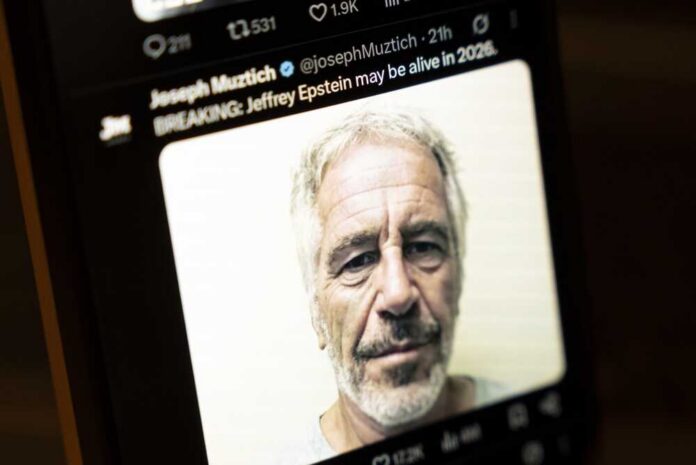
A forensic pathologist who spent months studying Jeffrey Epstein’s autopsy records now says the marks on his neck don’t match a suicide by hanging.
Story Snapshot
- Dr. Michael Freeman reviewed never-before-published autopsy photos and a biomechanical reconstruction and concluded Epstein’s injuries point to homicide, not suicide.
- The 2019 ruling by the New York City medical examiner still stands as suicide, and the Justice Department’s inspector general found no evidence of a crime.
- No scene photos were taken of Epstein’s body, and the ligature used was never preserved or tested.
- The FBI says footage from the night Epstein died shows nobody entered his housing unit, backing the suicide finding.
A Forensic Review Reopens an Old Question
Michael Freeman, a forensic pathologist, spent months going through autopsy records given to him by Epstein’s brother, Mark. The files included photos and a biomechanical reconstruction that had never been made public before. Freeman told CBS News the injuries “were not consistent with the suicidal hanging.” He pointed to horizontal marks on Epstein’s neck that he says look like a ligature pulled from behind, not one tightened by a falling body.
Freeman also flagged marks on Epstein’s face and shoulder, along with fingernail-like scratches above the ligature line. He says those injuries were overlooked when the original death ruling was made. His review does not come from new crime-scene evidence. It comes from a fresh read of old photos and records, filtered through his own expertise in wound patterns.
What the Government’s Own Investigators Found
The New York City medical examiner who performed the autopsy told Justice Department investigators the opposite. She said Epstein’s injuries matched suicide by hanging better than homicide by strangulation, and that there were no defensive wounds on his body at all. A correctional officer told federal investigators the body looked “pristine,” with no bruising and nothing under the fingernails.
The Justice Department’s inspector general dug deep into Epstein’s death in 2023. Investigators found serious misconduct by jail staff, including failing to check on him and skipping required rounds. But the report still backed the FBI’s conclusion that his death was not the result of a crime. The FBI later said its own review of overnight camera footage showed no one entered the housing tiers between Epstein’s lockup and when he was found.
That split sums up the entire fight. One side studied photographs years after the fact and reached a homicide conclusion. The other side includes the medical examiner who did the original exam, the correctional officer on scene, and two separate federal reviews, all landing on suicide. Common sense says the people who were actually there, under oath, carry real weight here.
The Gaps That Keep the Debate Alive
Freeman’s review highlights something harder to dismiss: investigators never photographed Epstein’s body at the death scene, and the bedsheet used as a ligature was never preserved or tested. Those are real, documented holes in the record. They don’t prove murder, but they do mean nobody can fully rule anything out using physical evidence that simply no longer exists or was never collected properly.
Freeman’s source material also came entirely through Mark Epstein, Jeffrey’s brother, who has publicly pushed back on the suicide finding for years. That doesn’t make the records fake. But it does mean outside pathologists haven’t yet had a chance to check Freeman’s work using the same files, under the same conditions, without a family member controlling access first.
https://x.com/DailyMail/status/2122431484732858400
Why the Island Footage Doesn’t Change the Picture
Separately, newly surfaced drone and walkthrough footage of Epstein’s private island, Little Saint James, has circulated widely online, showing cameras, a bunker-like structure, and a server room. It’s striking material. But none of it connects to how Epstein died at a federal jail in Manhattan. The island and the Metropolitan Correctional Center are different places, different years, and entirely different evidence.
Treating island footage and autopsy photos as one single story risks muddying a question that actually deserves a clear answer. Americans are right to want a real resolution on how Epstein died. That goal gets harder, not easier, when unrelated footage gets lumped in with a legitimate forensic disagreement.
What Would Actually Settle This
The real fix here is simple: release the full autopsy file, the original photographs, and any remaining physical evidence to multiple independent pathologists for an anonymous review, not just one expert working from material supplied by family. Depositions from the medical examiner, jail staff, and federal investigators under oath would also help close the gap between a documented official finding and a single competing opinion.
Until then, the public is left weighing one expert’s read of old photos against sworn statements, a formal autopsy, and two federal investigations that reached the same conclusion. That’s nothing. But it’s also not yet enough to overturn a death ruling that has held up under repeated scrutiny for six years.
Sources:
cbsnews.com, justice.gov, oig.justice.gov, independent.co.uk