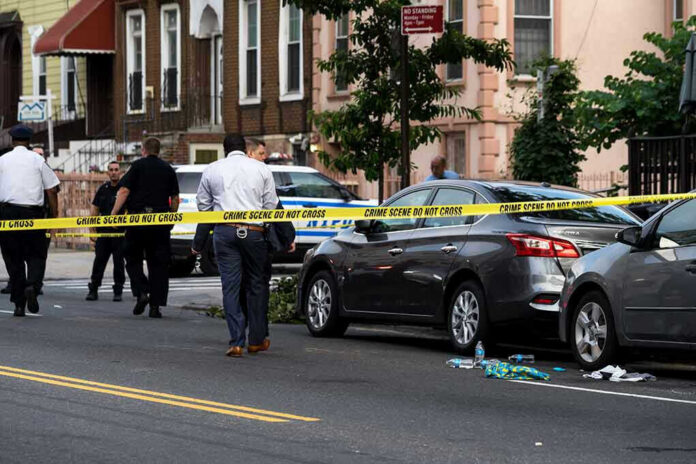
One June afternoon in small-town Iowa, a 52-year-old grandfather allegedly moved from house to house and business to business, executing six of his own relatives before turning the gun on himself in what the local police chief called “an act of evil.”[1][3]
Story Snapshot
- A 52-year-old man in Muscatine is suspected of killing six family members at three locations before dying by suicide.[1][3]
- Police say the rampage grew out of a domestic dispute inside a multigenerational family web.[1]
- The killings unfolded across a home, another residence, and a local business that were all tied to the same family.[1]
- The case exposes how fragile family peace can be when resentment, history, and a gun collide behind closed doors.[1]
A quiet Iowa city, a normal Monday, then seven people dead
Muscatine, Iowa sits along the Mississippi River, about 50 miles southeast of Cedar Rapids, the kind of place most Americans would describe as calm, safe, and predictable.[1] Around lunchtime on a Monday, police were dispatched to a Park Avenue home after reports of a shooting.[1][3]
Officers walked into a scene that defied that small-town sense of security: four people inside, all with gunshot wounds, all already dead.[1][3] From that moment, the day stopped being routine for the entire city.
BREAKING: Seven people, including the suspected shooter, were killed in a shooting spree in Muscatine, Iowa. Police believe the victims were members of the same family. pic.twitter.com/Lk8ojFeASz
— Breaking911 (@Breaking911) June 2, 2026
Investigators quickly focused on one name: 52-year-old Muscatine resident Ryan Willis McFarland.[1][3] Police say the evidence pointed to him as the shooter in that first home, and dispatchers learned he had already left the scene.[1][3]
While officers processed the residence, a second track of the investigation shifted to locating McFarland before anyone else was hurt.[1] The picture they were forming was not a random attack but something unfolding inside a single extended family.[1]
The riverfront encounter and a hunt for more victims
Officers eventually found McFarland on a riverfront trail near a pedestrian bridge, a public space that normally hosts joggers and families, not an armed suspect.[1][3] Muscatine Police Chief Anthony Kies said that as officers tried to talk with McFarland, he ended his own life there on the trail.[1][3]
First responders attempted lifesaving measures, but he was pronounced dead at the scene.[1][3] That suicide denied the community, and the victims’ families, any future courtroom testimony about what had driven him.
The story could have ended with four dead and one suicide, but investigators kept getting tips that something broader was unfolding.[1] As they followed those leads, officers located another adult male in a different Muscatine residence, dead from an apparent gunshot wound.[1][3]
Not long after, they found yet another adult male, also fatally shot, inside a business on Grandview Avenue.[1][3] Every new address widened the horror but pointed back to the same suspect and the same family network.[1]
A domestic dispute that turned into a multi-scene massacre
Muscatine’s police chief told the public that the preliminary investigation shows the killings stemmed from a domestic dispute.[1] Authorities said all six victims were believed to be relatives of McFarland, not random strangers.[1]
That fits a troubling pattern researchers have seen for years: some of the deadliest acts of violence in America happen within families, after long histories of conflict that rarely make the news until it is too late. Early reports did not detail the specific grievances, but the domestic frame has become the working motive.
UPDATE: 7 people dead after murder-suicide in Muscatine; school district responds https://t.co/miuxwEoGgx
— 8News WRIC Richmond (@8NEWS) June 2, 2026
Police and local outlets reported that the victims included multiple generations and that at least one of the scenes involved a family business.[1] Authorities had not publicly released all names or ages in the earliest coverage, but they stressed that this was not a case of a stranger targeting a city; it was a family annihilation radiating outward from private tensions.[1]
That matters for public understanding, because it shifts the question from “How did this happen here?” to “What was boiling inside this household for years?”
Law enforcement response and the problem behind the front door
Chief Kies labeled the murders an “act of evil,” and that is more than a sound bite.[1][3] From a common-sense perspective, this is exactly how a community should see such behavior: not as inevitable, not as a vague tragedy, but as a deliberate, moral catastrophe carried out by one person against his own kin.
Authorities noted McFarland had a prior criminal history, though they did not immediately provide details.[1] That raises serious questions about how previous behavior, access to firearms, and accountability intersected before this rampage.
Police did not blame a law, a political slogan, or some abstract social force; they focused on the suspect’s choices and the domestic conflict at the core.[1] That framing aligns with a view many Americans share: rules matter, consequences matter, but individual responsibility matters most. At the same time, the case highlights a harder truth.
No law can fully police the space inside a family home, where resentment, control, and fear either get addressed early or metastasize. When warning signs go unspoken or ignored, a single armed, determined person can destroy an entire bloodline in an hour.
What Muscatine’s “act of evil” leaves behind
The Muscatine killings collapsed multiple roles—father, relative, alleged murderer—into one man whose last act was to silence himself.[1][3] Without a trial, the public will likely never hear a complete narrative of what led to the domestic dispute or how many chances there were to intervene.[1]
What remains is measurable: six dead family members, one dead suspect, a shaken small city, and a police chief reminding everyone that evil is not an abstract concept. It can be a familiar face at Sunday dinner who decides one day to pick up a gun.
Sources:
[1] Web – Police investigate Iowa man suspected of killing six of his relatives …
[3] Web – In the US, a gunman killed six family members and himself | УНН