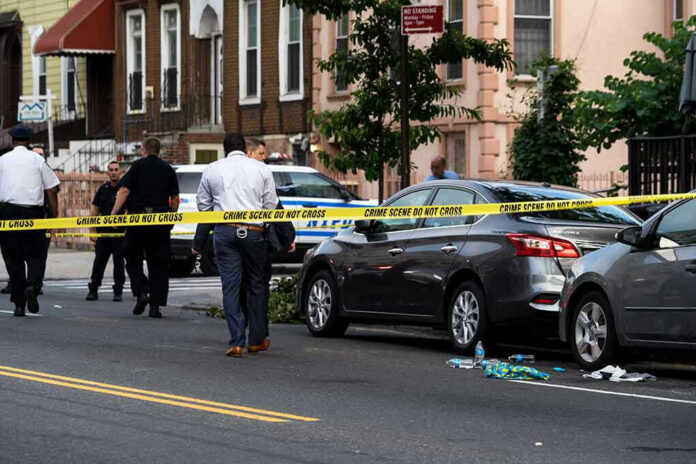
Nine mass shootings in one American weekend left nine people dead, at least 60 wounded, and a trail of confusion about what the numbers even mean.
Story Snapshot
- At least nine mass shootings hit eight states in a single weekend, leaving nine dead and more than 60 hurt.
- News outlets could not agree on the basic math, reporting 9, 12, or even 6 deaths for what appears to be the same cluster of days.
- Different groups use different definitions of “mass shooting,” which quietly shifts the totals and fuels public doubt.
- The mess in the data raises a hard question: how do you make policy from numbers no one can pin down?
One violent weekend, nine mass shootings, and a shaky scorecard
Across one weekend, at least nine separate mass shootings erupted in the United States, leaving nine people dead and at least 60 wounded, according to one national report that pulled from police and tracking databases.
The incidents stretched across Colorado, Delaware, Maryland, North Carolina, Oklahoma, Arizona, Tennessee, and two separate shootings in Minnesota, showing how quickly gun violence can ripple from city to city when the week’s work is done and the weekend begins.
On paper, that sounds clear enough: nine shootings, nine dead, about five dozen injured. Yet other national outlets, describing what appears to be the same general weekend wave, put the death toll at “at least 12” or referred to five deaths in nine shootings, not nine.
A Newsweek map of one such weekend listed six people killed and 64 injured nationwide. None of these stories are “fake”; they are counting different things in different ways, without saying so plainly.
9 dead, 60 hurt in 9 different mass shootings across US https://t.co/Gu9Z5FUVNE
— This Is The Conversation Project (@th_conversation) July 21, 2026
Why no one agrees on the numbers
The confusion starts with the definition of a “mass shooting.” The Gun Violence Archive, a widely used tracker, defines it as any incident where four or more people are injured or killed with a gun, not counting the shooter.
That includes public attacks, family murders, gang fights, and street disputes as long as four or more people are hit. Cable news and many websites often follow this rule of “four shot or killed” without always spelling it out.
Other researchers use stricter rules. Some focus only on public attacks where at least four people are killed, not just wounded, and where the motive is not gang or drug crime.
Everytown for Gun Safety includes any case where four or more people are shot and wounded or killed, but other academic databases will drop domestic violence or robbery cases and count only “indiscriminate” public attacks. When each outlet quietly picks a different rule, they can look at the same weekend and come back with very different totals.
Weekend violence fits a larger pattern
Researchers have found that shootings climb in the summer, on weekends, and at night. One study of six large American cities showed that gunfire was more common on weekends and holidays and during hotter months.
Another analysis of multiple-victim shootings showed that these events happen more often on weekends, major holidays, and during hotter seasons. In other words, a bloody summer weekend with multiple mass shootings is not a freak event; it is the pattern we have built and now live inside.
Gun Violence Archive data and news digests show weekend clusters like this again and again: seven mass shootings here, ten there, sometimes more. In recent years, there have been dozens of such weekends where four or more incidents meet the “four victims” threshold.
The exact numbers shift depending on who counts, but the rhythm is the same: workweek, then weekend, then a fresh round of names and candles on sidewalks.
How sloppy definitions feed public distrust
For a citizen trying to make sense of this, the clash in counts is not a small detail. When one major outlet says nine mass shootings killed nine people and wounded around 60, and another says that “at least 12” died in a string of weekend shootings, trust takes a hit.
If newsrooms and advocacy groups cannot agree whether the toll was nine, twelve, or six, people begin to suspect that the numbers are driven more by narrative than by careful record-keeping.
9 separate mass shootings across US leave 9 dead, 60 injured over the weekendhttps://t.co/Ez8Xy508nt
— Rose PArsons (@lilstuffParsons) July 21, 2026
American instincts push hard against this kind of statistical fog. Law-and-order voters want clear facts: what happened, where, who was hurt, who did it, and why.
Common sense says you cannot craft sound law or judge the impact of past policies if your basic counts swing wildly because some researcher quietly deleted domestic cases and another lumped everything together. When the same year can show six mass shootings by one measure and over 400 by another, the term itself starts to lose meaning.
What this means for policy and for families
Families in those eight states do not care whether their nightmare fits the Gun Violence Archive definition or some academic standard. They care that a child did not come home from a party at a bar, a church event, or a neighborhood street game.
For them, the only honest number is one: the chair that sits empty now. Yet for lawmakers and citizens, the way we count these weekends influences everything from police funding to gun laws, to how we talk about crime and personal responsibility.
Two demands can be made at once: tell the truth about the scale of violence, and be just as honest about how you count it.
That means police and media should state which definition they use, separate public rampage attacks from domestic or gang shootings, and keep the math tight. Without that discipline, every new “bloody weekend” headline risks becoming just another data fight in a country already tired of spin, while the bullets keep landing in the same neighborhoods.
Sources:
abcnews.com, theguardian.com, today.com, apnews.com, newsweek.com, cnn.com, abcnews.go.com, youtube.com, pbs.org, pmc.ncbi.nlm.nih.gov, en.wikipedia.org, pinkerton.com