

Two teenage boys walked into their own classroom in Tacloban and opened fire on classmates they say bullied them — and that single act exposes a much bigger fight over blame, security, and what adults missed.
See the video below.
Story Snapshot
- Two students, ages 14 and 15, allegedly shot classmates at San Jose National High School, killing three and wounding seven.
- Police say bullying was the suspected motive, but early facts and even the victim list still do not fully line up.
- The guns came from adults, security was thin, and police admit warning signs may have been ignored.
- Philippine leaders now promise more security, while parents are left asking why no one acted sooner.
A rare school shooting that shattered a normal Monday
San Jose National High School in Tacloban City opened on Monday like any other government school, with more than 1,500 students filing into class.[3] By mid-morning, two of those students, boys just 14 and 15 years old, were in custody, and three of their classmates were dead.
Police say the pair walked into a classroom with pistols and started firing without saying a word, sending students running and diving for cover.[1][5] Seven others were hurt, some by bullets and some in the panic.[1]
Officers arrived fast enough to grab one suspect on campus, while the second fled and hid in a nearby home until residents tipped off police.[3][6] Both boys were students at the school, and so were all the victims.[3]
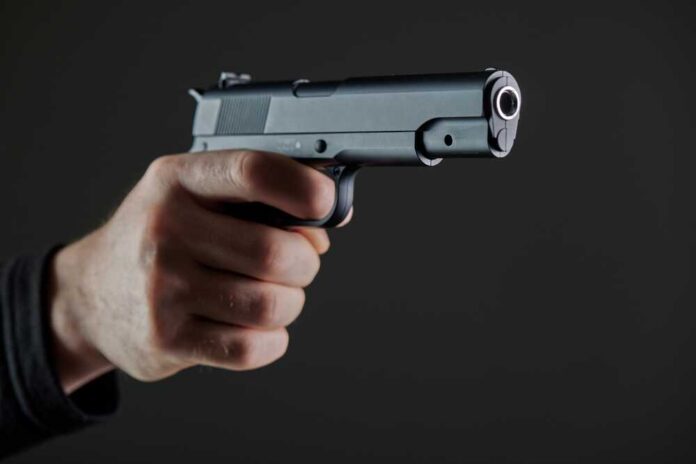
Investigators recovered two handguns, a .38-caliber revolver and a 9 millimeter pistol, and collected dozens of spent shells from the scene for forensic work.[1][5] What looked, at first, like a random rampage is already being framed as something else: payback for bullying.
Bullying as motive – truth, excuse, or convenient cover?
Police officials say early questioning points to bullying as the reason the boys opened fire.[3][8] A police information officer said they were “hearing bullying was the motive,” even before detailed interviews were done.[8]
Another senior officer said the teens were close friends and told police they had been bullied at school.[3]
That claim fits a common pattern in school shootings: authorities lean toward a “grudge” story that makes the attack sound targeted, not random.[9] It makes the horror feel containable — bad kids, bad choices, tragic but limited.
At least three people were killed and five others injured in a school shooting in Tacloban, Philippines. https://t.co/vVVljK3dyk
— Breaking911 (@Breaking911) June 22, 2026
This is where common sense needs to kick in. When teenagers claim bullying after killing classmates, Americans who value both accountability and fairness should demand proof, not just a narrative that quickly closes the book.
Police still do not even know if the supposed bullies were in the classroom where shots were fired.[1] That gap matters. If the attackers did not hit the people they claimed to hate, then the “bullying grudge” may be more excuse than explanation.
Security failures, adult guns, and missed red flags
For many parents, the more pressing question is not why the boys were angry, but how they got armed and inside the school in the first place.
Investigators say one of the pistols was registered to a policewoman related to one suspect, raising serious questions about how securely those guns were stored at home.[1]
Reports say there was only one guard at multiple school entrances, making it easier for the boys to walk in carrying weapons.[6] Police themselves have said warning signs may have been overlooked before the attack.[1]
That picture should alarm anyone who believes adults have a duty to protect children. You have unsecured firearms in a relative’s home, thin security at a big public school, and possible red flags that no one acted on. That does not erase individual guilt, but it does spread responsibility.
A view that values order, family duty, and the rule of law cannot ignore the adults who left loaded guns where teenagers could grab them, then send those teens into a campus guarded by one person with a whistle and a radio.
A “rare” event in the Philippines, but part of a global pattern
Officials and reporters have called this shooting “rare” for the Philippines, and compared with the United States, it is.[3][5] American data show hundreds of K–12 shooting incidents in recent years and more than 390,000 students exposed to gunfire at school since Columbine.[8][11]
Most school shooters are young and male, often current or former students, just like the Tacloban suspects.[8][9] The Philippines still faces far fewer school shootings than the United States, but experts list it among countries with notable public mass shooting histories worldwide.[12]
TRIGGER WARNING: Sensitive Content
Officials from the DepEd Central Office check on learners who were hospitalized following the shooting incident at San Jose National High School in Tacloban City on Monday, ensuring that their safety, welfare, and immediate needs are being… pic.twitter.com/0xlKLZER9d
— The Philippine Star (@PhilippineStar) June 22, 2026
That broader pattern matters because it shows how often the same script repeats. A shocking attack hits a school. Early reports conflict on casualty counts. Police stress that such events are unusual.
A simple motive — bullying, a grudge, a fight — gets pushed out fast. Leaders, including President Ferdinand Marcos Jr., then promise investigations and tighter security in schools and other public places.[3]
The cycle moves on before citizens ever see the security logs, discipline records, or the full truth about what adults did or failed to do.
What accountability should look like after Tacloban
The hard work now is not one more press conference; it is pulling records and forcing answers. That means tracking the gun from the policewoman’s registration to wherever it was kept, and asking whether basic safe-storage rules were followed.[1]
It means reviewing camera footage, gate logs, and staffing records to see whether the school met the minimum required to protect 1,500 students. It also means testing the bullying claim with real evidence from classmates and teachers, not accepting it as gospel because two scared boys said it under pressure.
For readers who believe in both personal responsibility and limited but effective government, this case is a stress test. The shooters, if proven guilty, chose evil.
But adults built the world that made their choices deadly — with lax gun storage, weak school security, and a culture that spots “red flags” only after the funerals.
The question after Tacloban is not just who fired the shots. It is whether the people in charge will allow real scrutiny, or hide behind the easy story of two bad kids and a bullying grudge.
Sources:
[1] YouTube – Students seen crying after shooting at a high school in the …
[3] Web – Three dead in Philippines high school shooting over bullying ‘grudge’
[5] Web – Two suspects in custody after shooting at high school in Philippines …
[6] Web – Philippines’ Marcos Orders Probe Into School Shooting That Killed …
[8] Web – Ateneo de Manila University shooting – Wikipedia
[9] Web – At least three students were killed and five others wounded on …
[11] Web – 2 students in custody after shooting at high school in Philippines …
[12] Web – Two students arrested after three killed in Philippines school …