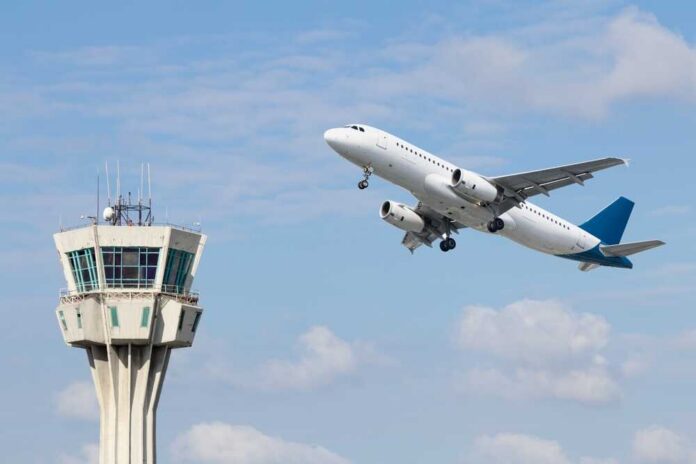
A JetBlue pilot said a drone smacked the jet at 3,000 feet—yet mechanics found nothing.
Story Snapshot
- Pilot of JetBlue Flight 948 radioed a drone impact above the cockpit on approach to JFK[3]
- Federal Aviation Administration (FAA) opened an investigation; findings pending[1]
- JetBlue pulled the Airbus from service; inspection found no damage or strike evidence[1]
- Prior cases show similar claims often end with zero physical proof[11]
The moment: a clear claim, a clean airplane
JetBlue Flight 948 from Las Vegas neared John F. Kennedy International Airport when the pilot told controllers the plane hit a drone “right above the cockpit.” The statement went out on live radio and spread fast across newsrooms and social feeds.
The Federal Aviation Administration confirmed an investigation. JetBlue removed the aircraft from service for checks. Inspectors reported no damage and no trace of impact on the nose or windshield areas.[1][3]
The clean inspection shifted the debate from “what hit the plane?” to “did anything hit at all?” The Federal Aviation Administration has not released radar or surveillance proof of a drone in that airspace.
No operator has been found. No other crew reported a strike. Those gaps do not prove the pilot wrong, but they leave his claim standing alone without hard support in metal, glass, or data.[1]
Why pilots report strikes that vanish on the ramp
Final approach stacks stress, speed, and sensation. Pilots juggle checklists, traffic, and weather while scanning for hazards. Bright objects, balloons, birds, and even reflections can appear close and fast. Prior events mirror this one.
A United flight into San Diego in 2024 reported a drone hit and then flew on after a clean inspection. No physical proof turned up there either. The base rate favors false alarms when evidence is missing.[11]
A JetBlue pilot reported their plane possibly struck a drone at 3,000 feet while on final approach to John F. Kennedy International Airport. The plane landed safely, and all passengers were able to exit normally. https://t.co/OirVItoMia pic.twitter.com/JlqKgCnToK
— CBS Evening News with Tony Dokoupil (@CBSEveningNews) June 29, 2026
Policy research paints drone-airliner collisions in the United States as vanishingly rare. One analysis found no confirmed consumer drone strikes on U.S. airliners to date, despite widespread drone use.
The paper modeled risk and still deemed it very low for passenger injury from small drone impacts. That does not make the threat fake. It means the prior odds argue for caution before calling any single report a confirmed hit.[12]
What the facts support today
Three facts hold. First, the pilot gave a clear, real-time report of contact near 3,000 feet on approach to New York City airspace. Second, the Federal Aviation Administration is investigating and reviewing data, but it has not verified a drone’s presence.
Third, JetBlue’s maintenance team found no damage or residue and released that finding publicly. These facts place the incident in a narrow lane: credible voice report, zero physical proof, and an open case file.[1][3]
🚨 #BreakingNews 🚨
"JetBlue Flight 948 Reports Mid-Air Drone Strike on Final Approach to JFK Airport; FAA Launches Investigation After Airbus A321 Lands Safely With No Damage"
➡️ JetBlue Flight 948, an Airbus A321 traveling from Las Vegas to New York City, reported a direct… pic.twitter.com/eD8E5UxxIw— BreakinNewz (@BreakinNewz01) June 29, 2026
Some outlets lean on the “no damage” line to dismiss the pilot. That skips the duty to weigh both human factors and the lack of forensic signatures. Others hype the strike to argue airports are swarmed by drones. That stretches beyond the record.
Reckless drone flying near airports is dangerous and illegal, and extraordinary claims need hard evidence before we change rules, spend billions, or panic travelers.
What would settle it
Two data sets could close the loop. Air traffic control audio and radar tracks for the time window could show a non-cooperative object near the flight path. High-resolution checks of the jet’s nose, windscreen, and radome for micro-abrasion or transfer material could also help.
Freedom of Information Act requests could surface the radar and surveillance records. If nothing shows on sensors and the airframe stays pristine, the likely verdict is near-miss perception, not impact.[1][3]
The right play now is measured enforcement, not myth-making. Keep strict penalties for drone operators who break airspace rules. Expand geofencing near major airports. Improve reporting so controllers can tag and track unknown objects faster.
Focus public funds on tools that find real threats, like better surveillance fusion at approach gates. Demand proof before declaring a strike. That balance protects both safety and sanity while the Federal Aviation Administration finishes the work.
Sources:
[1] Web – JetBlue flight reports striking drone while landing at JFK
[3] Web – DRONE STRIKE REPORTED at JFK Airport 29 JUN …
[11] Web – JetBlue pilot reports hitting drone while landing at New York’s JFK
[12] Web – DRONE STRIKE REPORTED at JFK Airport 29 JUN 2026 – Instagram