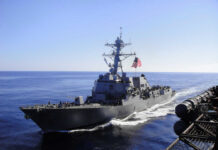
A Russian patrol plane came too close to Britain’s flagship carrier, and two F-35 jets sent it away.
Quick Take
- The UK Ministry of Defence said a Russian Bear-F repeatedly approached HMS Prince of Wales in the Norwegian Sea.
- The ministry said the plane flew low, came uncomfortably close, and dropped sonobuoys nearby.
- Two British F-35 jets intercepted the aircraft and escorted it until it left the area.
- The official dispute is narrow: the UK account is detailed, but no independent flight data appears in the available reporting.
The Close Pass That Raised the Temperature
The incident matters because it was not just a distant radar blip. The British account says a Russian maritime patrol aircraft repeatedly approached a carrier strike group operating in the Norwegian Sea, then moved in low and close to HMS Prince of Wales.
That mix of proximity, surveillance gear, and fighter escort turns a routine patrol into a sharp warning shot. It also explains why the story spread fast across defense and general news outlets.
Russian aircraft intercepted by RAF jets after 'repeatedly approaching' Royal Navy ships in the Arctic https://t.co/1uFbIfsA6w
— Daily Mail (@DailyMail) July 6, 2026
The Ministry of Defence said the Russian Bear-F dropped 10 sonobuoys into the water and did not answer calls on international frequencies. British forces then sent two F-35 jets from the carrier to escort the aircraft away.
Reuters reported the same core sequence, including the description of the activity as unsafe and unprofessional. For readers used to the slow grind of maritime patrols, this is the kind of close encounter that can feel bigger than its map coordinates.
What the UK Says Happened
The official British version is straightforward. While the carrier strike group was on Operation Firecrest, the Russian plane reportedly came back again and again. The Ministry of Defence said the aircraft passed at low altitude and “unnecessarily close” to the carrier.
It also said the aircraft dropped a large number of sonobuoys near the ship. Those devices are used to listen for submarines, which is why the episode immediately carried a military edge.
That detail matters. Sonobuoys are not fireworks or loose debris. They are part of undersea surveillance, and dropping them near a carrier suggests more than casual overflight. The British side clearly wanted to frame the move as deliberate pressure, not harmless transit.
The Reuters report and the BBC account both repeat that the plane did not respond to contact attempts, which strengthens the case that the encounter was at least operationally tense.
Why This Story Fits a Larger Pattern
This was not the first time Russian aircraft have tested NATO nerves near the High North. A longer analysis of Russian incursions into UK air and sea space found repeated activity over many years, with airspace incidents more common than sea intrusions.
That background matters because it keeps this event in perspective. The carrier episode looks dramatic, but it also fits a familiar pattern of probing flights, intercepts, and public warnings that have become almost routine in northern waters.
The High North is a region of strategic importance, where @NATO Allies continue to operate together to preserve security and stability, as part of Arctic Sentry.
While conducting routine operations in the Norwegian Sea, the UK's Carrier Strike Group encountered repeated activity… pic.twitter.com/QRBC6vvn5L
— NATO Allied Joint Force Command Norfolk – JFCNF (@JFCNorfolk) July 7, 2026
That pattern cuts both ways. On one hand, it helps explain why Britain reacted quickly and publicly. On the other, it shows why outsiders should be careful about reading too much into one side’s language.
The available reporting gives the British case in detail, but the evidence in the package does not include Russian flight logs or neutral radar data. So the core fact is the intercept, while the sharper claims about intent and exact distance remain based on the UK account.
The Missing Pieces That Keep the Debate Open
What is still missing is the kind of proof that would settle the argument cleanly. The strongest sources in the package describe the event in the same broad way, but they do not publish raw radar tracks, cockpit audio, or exact range data.
That leaves room for debate about how close “unnecessarily close” really was. It also leaves the charge of unsafe conduct rooted in official judgment, not independent technical review. In a story like this, that gap matters.
Still, the broader lesson is easy to see. The UK wants to show that it can protect a carrier group far from home. Russia, meanwhile, gains if these flights look like normal patrols and the intercepts look exaggerated. That is why this encounter matters beyond the Norwegian Sea.
It is a small event with a large message: in the High North, distance is not comfort, and a few minutes of bad flying can become a political signal.
Sources:
cbsnews.com, mezha.net, stripes.com, instagram.com, x.com