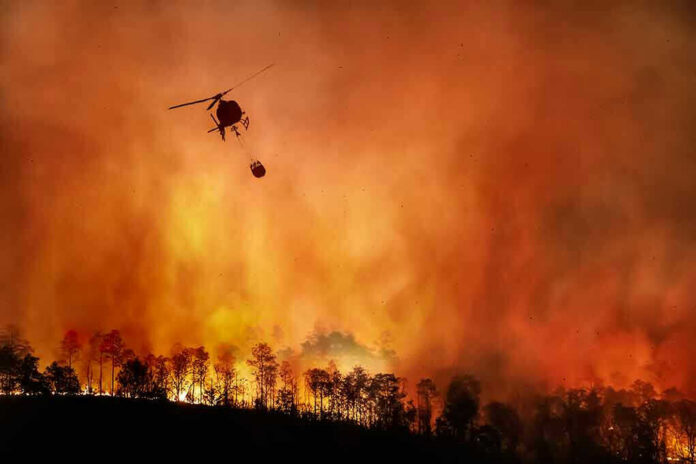
When a lush wine coast and a royal capital both start emptying by the hundreds of thousands, you are not watching “normal” wildfire season anymore—you are watching modern Europe learn what real disaster feels like.
Story Snapshot
- About 200,000 people fled fires in southwest France and central Spain in a matter of days.
- Evacuees escaped Bordeaux’s Atlantic coast by car and even by boat as flames pushed to the shoreline.
- Spain declared a national emergency for wildfires near Madrid and Ávila for the first time.
- France deployed troops and sought European aircraft as it fought what officials called its worst wildfire on record.
Two European heartlands turned into evacuation zones
Southwest France and central Spain did not just “have fires.” They turned into live evacuation maps. French authorities said roughly 141,000 people fled the Gironde and Landes departments, home to Bordeaux and its Atlantic holiday strip.
Spanish officials reported about 60,000 displaced or ordered indoors near Madrid and Ávila as flames advanced on satellite suburbs and historic hill towns. Put together, more than 200,000 people were suddenly living out of bags, cars, gym mats, or borrowed spare rooms.
Towns that sell calm as a lifestyle woke up to police knocking on doors. Officers rolled street to street, telling families to leave now, not later, as smoke columns rose from nearby woodlands.
Some residents on France’s Atlantic coast watched flames jump past dunes and scramble through pine forests that usually frame summer postcards. They did not wait for a second knock. People grabbed kids, pets, and documents, then joined lines of cars inching toward safer ground or, in some cases, toward the water.
When roads fail, people get on boats
The scene along France’s Atlantic tourist belt looked more like a war film than a holiday brochure. Flames cut across peninsulas known for oysters and surfing, not for disaster drills. As fire closed in on the Cap Ferret area, some residents and tourists chose the one route fire could not block: they fled by boat.
Skippers loaded families and gear and pulled away while thick smoke hugged the shoreline. That decision says more about how extreme the situation was than any statistic—when citizens trust the bay more than the highway, something is deeply wrong.
Wildfires in Spain are completely out of control. More than 300.000 people across Spain and France have been evacuated.
Heroic firefighters are fighting day and night to prevent it from spreading further.
Thank you for your immense service. pic.twitter.com/EmH4t5JHq8
— France Safety Travel (@francesafetytra) July 26, 2026
On land, evacuees were moved to towns like Arcachon, where schools, gymnasiums, and exhibition halls became overnight shelter villages. Rows of camp beds and plastic chairs replaced trade shows and concerts.
For many, the first question was simple and haunting: would there be anything left to go home to? There were injuries among firefighters, but authorities reported no civilian deaths in this wave, which means the evacuation machine, for all its chaos, did its main job.
Governments hit the big red buttons
This was not a routine local brushfire handled by a few trucks. France’s Interior Minister reported historic burn totals for the year and pushed thousands of personnel into the field. President Emmanuel Macron ordered the armed forces to mobilize to reinforce exhausted firefighters and civil protection crews.
Spain’s Interior Minister invoked a national emergency for wildfires, a first, as merged blazes near Madrid and Ávila tested what the country’s regular fire lines could handle. These are “break glass” moves; governments do not declare national emergencies to impress activists on social media.
The test here is simple: did officials focus on life and property, or on slogans? On this record, the core response looks like hard-nosed priorities.
Commanders shifted police away from events such as the Tour de France, shortening its final stage so security forces could back evacuation operations and traffic control. That is the kind of trade a serious country makes when people are at risk. You protect families first, then finish the race if you still can. That choice fits common sense and basic duty.
Firefighting turned into a military-grade operation
The scale of the firefight itself reads more like a campaign plan than a municipal incident log. France deployed well over a thousand firefighters supported by aircraft and soldiers as the Gironde blaze generated its own wind and “fire clouds.”
The government called in European Union help, securing Croatian Canadair water bombers, Portuguese Air Tractor planes, and Black Hawk helicopters from Czech and Slovak crews. Spain received Canadair aircraft from Italy and Greece as more than a thousand soldiers joined the effort near Madrid and Ávila.
🚨 BREAKING: 360,000+ evacuated as wildfires rage across France and Spain. 42,000 ha burned in Gironde alone – worst since WWII. Flames advancing toward Bordeaux wine region. Spain declares national emergency. $WEATHER $EURO #Wildfires #ClimateEmergency
— GlobalFlash (@GlobalFlash_Cam) July 27, 2026
On the ground, commanders talked openly about limits. Spanish emergency chief Carlos Novillo said parts of the blaze were beyond the capacity of firefighters to contain directly, forcing a shift to defensive measures around towns rather than heroic charges into unworkable terrain.
That kind of blunt admission matters. It tells the public these fires were not routine accidents that better messaging could fix. They were fast, hot, and structurally hard to stop once they reached certain slopes and fuel loads.
The numbers jump, but the direction is clear
If you scan headlines, the evacuation count bounces all over: 141,000, 167,000, 200,000, 250,000, even 300,000-plus depending on the day and the outlet. That is what happens when reporters chase live briefings while mayors, ministers, and police update tallies town by town.
But the exact figure matters less than the pattern. Every serious source agrees on the basics: this was a cross-border crisis, it displaced hundreds of thousands, and it forced France and Spain to stretch fire and military assets to the limit.
For a reader who values order, borders, and basic competence, this episode is a warning and a test. The warning is that even rich, well-organized countries can see their favorite regions emptied in forty-eight hours when fuel, heat, and wind line up.
The test is whether leaders treat that reality as a cue for more practical risk management—better forest work, tougher building rules, smarter evacuation planning—rather than just another excuse to score points in climate arguments.
The families who fled by boat were not debating hashtags. They were looking at fire on the beach and smoke in the sky and doing what free people do when danger comes close: moving.
Sources:
youtube.com, nbcnews.com, wsj.com, whmi.com, abcnews.com, dailysabah.com, barrons.com, bbc.com