
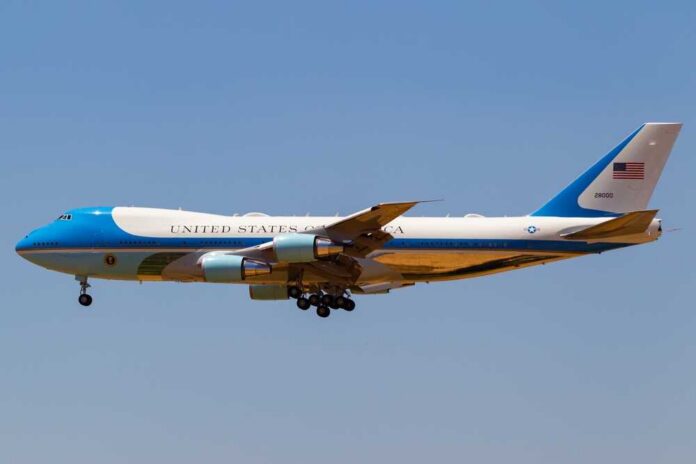
Two low passes by the presidential aircraft over the White House raised safety questions, caused flight delays, and sparked a fast-moving oversight fight.
Story Snapshot
- Flight-tracking showed passes roughly 400 to 1,000 feet over central Washington.
- Senator Tammy Duckworth demanded records on approvals, altitude rules, and warnings.
- Ronald Reagan Washington National saw a brief ground stop and widespread delays.
- The Federal Aviation Administration said it coordinated the operation.
What happened in the air, and why it matters
Flight-tracking data logged the presidential aircraft making two passes over the White House area, at altitudes reported between roughly 400 and 1,000 feet, and near the Washington Monument’s height. What grabs pilots and parents alike is the floor: altitudes as low as about 400 feet raise questions about the often-cited 1,000-foot minimum above landmarks in Washington. The White House defended the flyover as safe and coordinated. The sharpest disputes now turn on approvals, altitude rules, and notice.
🇺🇸✈️ AIR FORCE ONE gives DC residents one HELL of a Halloween jump scare.
Soaring near roof level, the surprise flyover gave locals an unusually close view right before the White House Halloween party.
Writer: Bri pic.twitter.com/IsXOoCPvHR
— Mario Nawfal (@MarioNawfal) October 29, 2026
Washington’s airspace is not normal. The National Capital Region sits inside a Special Flight Rules Area that binds everyone except specially authorized government flights. Presidential movements get priority handling and can trigger temporary changes that delay other traffic. These procedures anticipate reroutes, runway shifts, and pauses while the mission runs its course. A ground stop, by itself, does not prove something went wrong. It signals an operation that got first call on the sky.
Senator Duckworth’s oversight push
Senator Tammy Duckworth, who serves on the Senate aviation subcommittee, demanded a full accounting. She asked whether the Federal Aviation Administration objected to the plan, who approved the route and altitude, how notice flowed to residents and airlines, and whether the impact on passengers was weighed. That approach is the right way to test accountability. Ask for the records. Check the chain of command. Match the plan to the rules. Then decide if the system worked.
The Federal Aviation Administration said it coordinated the flyover and that Reagan National paused operations to accommodate it. The administration said the agency followed all necessary protocols. Those claims set a clear benchmark: if coordination happened as stated, the paper trail should show the authorization path, any waivers, air traffic directions, and alert timing. Conservative common sense says show the receipts and let the facts speak.
Rules of the sky in Washington
Federal guidance makes two things plain. First, Washington’s Special Flight Rules Area requires advance clearance and strict procedures for anyone entering that airspace. Second, presidential movements sit under special handling that can include temporary flight restrictions, which prioritize security and orderly flow. Reports cited the Federal Aviation Administration’s 1,000-foot minimum-above-monuments standard as a yardstick for the low passes. The key compliance questions are whether a waiver applied and how altitude was measured along the route.
The data gap centers on which altitude source controls. Public trackers estimate altitude differently than official radar, and ground elevation varies across the Mall. An exact figure decides little without the rule text and any exception in force. The smart next step is simple: compare the official radar and waiver record to the reported 400- to 1,000-foot band, then judge legality against the specific regulation cited in the authorization.
On the ground: delays, notice, and startled residents
Ronald Reagan Washington National saw a brief ground stop and reported knock-on delays during the flyover window. That effect aligns with how air traffic managers handle priority operations. The real test is whether the delay scale matched the plan’s scope and whether airlines got notice in time. Residents reported short warning windows. Some called 911 when the aircraft thundered low over downtown. A military public notice was reportedly posted late afternoon, which helps the defense but not those who missed it.
Public safety is not just about compliance in the tower. It is about trust on the street. If the plan was lawful and coordinated, tight local notice still left people surprised. Agencies can fix that with wider alert channels and earlier outreach the next time they plan a show-of-presence flight. If a waiver allowed the low passes, say so and publish the terms. Accountability calms tempers faster than spin.
What answers will close the book
Four disclosures would settle the debate. First, release the Federal Aviation Administration’s authorization, including any waiver of monument altitude rules. Second, publish official radar altitudes for each pass, tied to ground elevation. Third, show the traffic management log that ordered the Reagan National ground stop and the delay roll-up. Fourth, release the timeline for notices to residents, airlines, and local agencies. Those records exist. Produce them, and this story lands.
Sources:
thedailybeast.com, thehill.com, people.com, avweb.com, newsobserver.com, hawaiitribune-herald.com, faa.gov