

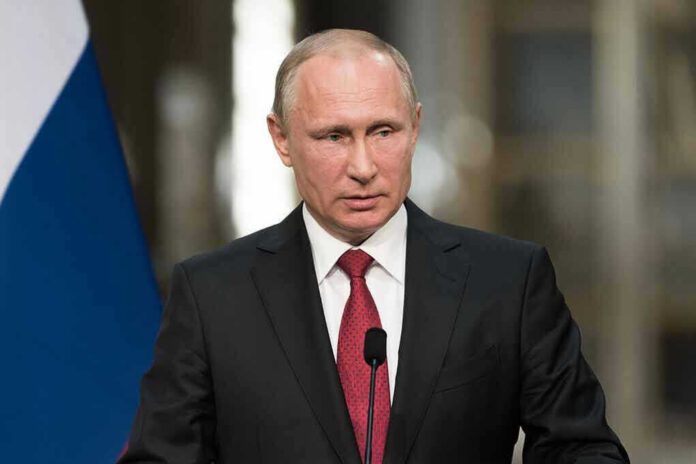
Russia freed American citizen Stephen Hubbard after four years in custody, and the handoff happened as a Trump envoy sat across from Vladimir Putin.
Story Snapshot
- Steve Witkoff said Russia released Hubbard during his meeting with Putin.
- Putin said Hubbard was taken to Pulkovo Airport in St. Petersburg.
- The State Department had labeled Hubbard wrongfully detained.
- Hubbard is a 74-year-old retired teacher and Michigan native.
What happened and who confirmed it
Real estate executive and presidential envoy Steve Witkoff confirmed Russia released Stephen Hubbard during his face-to-face meeting with Vladimir Putin in St. Petersburg. Multiple outlets reported Witkoff’s statement and linked it to his visit, which followed President Trump’s public push on the case. Russian state media also highlighted the development. The Associated Press and other major outlets treated the release as established fact based on these on-record statements and briefings.
Russian President Vladimir Putin said authorities took Hubbard to Pulkovo Airport after the release. That detail placed Hubbard in St. Petersburg, not a remote facility or an undisclosed site. British and American outlets carried Putin’s location note, which matched the timeline of Witkoff’s meeting and gave a clear point of reference for consular follow-up and onward travel.
Who Stephen Hubbard is and why it mattered
Stephen Hubbard is a U.S. citizen, a retired teacher, and a Michigan native. He was 74 years old at the time of his release. Reports say Russian forces detained him in eastern Ukraine in April 2022. He later stood trial in Russia and received a prison sentence of nearly seven years on charges that he fought for Ukraine. The U.S. government disputed the basis of the case and designated him as wrongfully detained in early 2025, which elevated his file for priority diplomatic action.
That designation does not only signal moral support. It triggers government tools designed for complex detentions, including the Office of the Special Presidential Envoy for Hostage Affairs. That office helps coordinate with allies, assess options, and line up exchanges or unilateral releases when possible. The label tells families that Washington treats the case as political and will negotiate hard, even when the other side calls it a standard criminal matter.
The path to release and the role of high-level diplomacy
Witkoff traveled to Russia to press for Hubbard’s freedom and met with Putin. President Trump had said before the visit that he raised Hubbard’s case directly with Putin. The sequence is simple: a sustained push by the White House, a targeted trip by a trusted envoy, and then an on-record statement by both sides that Hubbard was free and moving through St. Petersburg’s main airport. That is the classic arc of a political detention ending in a negotiated exit.
BREAKING: An American teacher held in Russia for years is finally free after President Trump personally pressed Vladimir Putin for his release.
Stephen Hubbard, 74, was detained after Russian forces invaded Ukraine in 2022 and later sentenced to nearly seven years in prison on… pic.twitter.com/586HCusTue
— StandupSpeakOut🇺🇸 (@StndupSpekup) October 21, 2026
American conservatives have long argued for two things at once: bring citizens home, and do not pay with permanent concessions. The available reporting does not outline any formal swap or written bargain connected to Hubbard’s release. If this was a unilateral humanitarian step, it aligns with common sense: raise the cost of taking Americans and reward good behavior only when it saves a life without weakening U.S. leverage. If a private understanding existed, the results still show pressure worked.
What the case says about today’s detention landscape
Hubbard’s ordeal fits a wider pattern. Governments that clash with the United States have leaned on prosecutions and closed trials to hold leverage. The United States, in turn, formally calls some cases wrongful detention and treats them as political, not ordinary consular work. The result is a gray zone where court files and diplomatic cables mix. That zone favors discipline and patience, not public theater, because quiet, focused talks often free people when loud gestures fail.
America has faced dozens of such cases worldwide in recent years, many lasting years and crossing wars, sanctions, and elections. Families need steady timelines and real updates, not spin. The lesson from Hubbard’s release is stark and practical: name the case, assign senior ownership, keep lines open to the top, and close the loop at an airport with a ticket home. That is not soft on rivals. That is tough on the problem and loyal to Americans in harm’s way.
The bottom line for policy and principle
Washington should keep three guardrails tight. First, treat every wrongful detention like a national mission, with the President’s attention on the highest-risk files. Second, deny long-term rewards to governments that seize Americans, because incentives shape future behavior. Third, move fast on proof-of-life, medical access, and legal counsel, and then negotiate with clarity and calm. Hubbard’s return shows that direct leadership and targeted diplomacy still bring citizens home from hard places.
One final note belongs here for context. Russia ran a closed trial and described Hubbard as a mercenary, while the United States labeled him wrongfully detained. Those narratives will not match. But the concrete result is not in doubt: Stephen Hubbard is out of a Russian prison and en route to life after captivity. That is the outcome that counts most to his family and to a country that promises to bring its people back.
Sources:
cbsnews.com, bostonglobe.com, cnn.com, bbc.com, foxnews.com, reuters.com