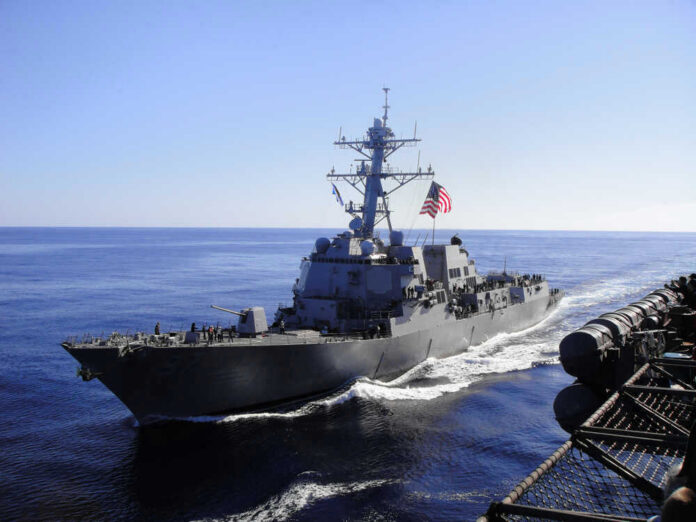
For four days in the South China Sea, a U.S. destroyer went dark, and the why matters.
Story Snapshot
- Navy says USS Benfold lost all power after a generator-related engineering casualty.
- Crew had no air conditioning, toilets, or normal galley service during the outage.
- No injuries reported; the incident is under investigation.
- Event raises broader questions about fleet maintenance and readiness.
What happened to USS Benfold and when
The U.S. Navy says the destroyer USS Benfold lost power on July 24 in the South China Sea due to an engineering casualty tied to its generators. The ship drifted without electricity for four days while operating with the USS George Washington Carrier Strike Group, according to Seventh Fleet.
A spokesperson reported no crew injuries. The Navy stated the cause remains under investigation. The event’s basic facts are not in dispute across initial reporting and official comments.
Shipboard life turned harsh fast. Loss of power meant no air conditioning, no working toilets, and limited galley services for hot meals. Crews trained for damage control kept the ship safe, while nearby U.S. vessels provided support as needed.
Reports describe a hot, cramped environment that tested morale and routine, yet the crew stayed focused on safety and restoration steps. These conditions track with what happens when a modern warship’s electrical backbone fails.
Why a generator failure sidelines a warship
Modern destroyers are floating power plants. Generators feed propulsion, sensors, radios, radar, weapons, refrigeration, water pumps, and life support. When that grid trips offline, the ship loses more than speed; it loses eyes, ears, and many comforts.
An “engineering casualty” is a Navy term that marks the effect, not the root cause. That could range from worn parts to timing on maintenance to an electrical fault. The Navy has said only that generators were involved.
Benfold’s blackout follows another power casualty this year. In May, the destroyer USS Higgins lost power and propulsion for hours in the Indo-Pacific after what the Navy called an electrical-system casualty.
That incident ended with no injuries, but it drew attention to reliability in the theater. Two high-visibility outages in one region in one year put a spotlight on upkeep, parts pipelines, and the strain of forward operations on aging systems and crews.
Readiness lens: the bigger pattern and stakes
Arleigh Burke-class destroyers carry a heavy load. They deploy often, stack upgrades, and run hard in hot, humid seas. A pattern of electrical or propulsion casualties, even brief ones, fuels questions about preventive maintenance cycles, shipyard capacity, and training for casualty recovery.
Media summaries noted this Benfold event as the second power-related destroyer failure in the region this year, a framing that ties a real incident to a readiness theme that Washington cannot ignore.
After a complete loss of power on the USS Benfold, sailors on board went four days with limited drinking water, and no working toilets or air conditioning.
https://t.co/S1qbQP6gpU— Central Oregon Daily News (@CODaily) August 19, 2026
Americans prize deterrence through strength and reliability. A front-line ship going dark for days in contested waters clashes with that standard. The Navy’s transparency that the generators failed and that the crew avoided injury is welcome.
But the stronger test is what changes next: parts availability, dock time, and hard-nosed engineering fixes that reduce repeat failures. Clear responsibility lines and fast corrective action align with common sense and with mission-first culture.
What to watch as the investigation proceeds
Watch for a public summary that names the trigger and the chain of events: component failure, wiring fault, software trip, or human error. Look for corrective actions fleet-wide, not only for Benfold.
Signals that matter include new inspection checks for generators, revised maintenance intervals, and spare parts positioned closer to Yokosuka. Also track whether the Navy adjusts deployment tempo to match shipyard bandwidth. Those are the levers that turn lessons into margin at sea.
The crew’s performance deserves credit. Four days without electricity tests any team. Reports say sailors held their procedures under pressure, protected the ship, and stabilized essential services as help arrived. That discipline is the last firewall when machines fail.
The next firewall is leadership that treats this as a readiness alarm, not a one-off. Fix the root causes, publish the lessons, and prove on the next patrol that the lights stay on when it counts.
Sources:
cbsnews.com, stripes.com, facebook.com, linkedin.com