President Trump reversed course Tuesday, extending a ceasefire with Iran indefinitely just hours after declaring he would resume airstrikes, raising questions about strategic coherence as Tehran parades missiles through its streets and the U.S. naval blockade tightens its grip on Iranian ports.
Story Snapshot
- Trump extends Iran ceasefire indefinitely via Truth Social, contradicting his morning stance against extension
- Extension granted at Pakistan’s request to allow Iran’s “fractured” government time to unify peace proposals
- U.S. maintains naval blockade of Iranian ports, which Tehran views as ceasefire violation
- IRGC seizes vessels in Strait of Hormuz as Iran parades missiles in Tehran, signaling defiance
Trump’s Dramatic Policy Reversal
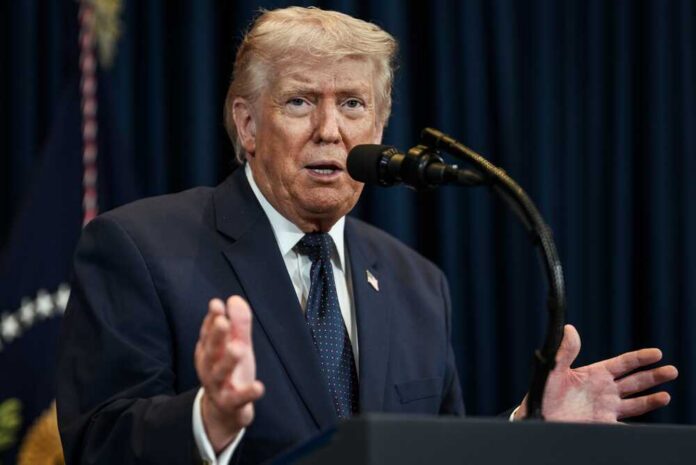
President Trump announced Tuesday afternoon on Truth Social that he would extend a two-week ceasefire with Iran indefinitely, hours after telling CNBC he would not grant an extension.
The reversal came at the request of Pakistan’s Field Marshal Asim Munir and Prime Minister Shehbaz Sharif, who urged more time for Iran’s fractured leadership to develop unified peace proposals. Trump had previously threatened to resume strikes on Iranian power plants and bridges if no deal emerged by the ceasefire’s Tuesday night expiration.
The sudden shift underscores the unpredictable nature of negotiations that have dragged on since U.S. and Israeli forces launched major combat operations against Iran in late February.
Blockade Tensions and Iranian Defiance
The United States maintains a naval blockade of Iranian ports and vessels, which Trump hailed as a “tremendous success” but Iran considers a violation of ceasefire terms. Tehran has refused to attend peace talks scheduled in Islamabad, Pakistan, as long as the blockade continues, creating a deadlock that threatens to unravel diplomatic progress.
Meanwhile, Iran’s Islamic Revolutionary Guard Corps seized two vessels in the Strait of Hormuz on Tuesday, and unconfirmed reports suggest an Iranian gunboat fired on a cargo ship. These provocations coincide with missile parades through Tehran’s streets, a public display of military readiness that signals the regime’s refusal to appear weak before its population or regional adversaries.
Strategic Leverage or Political Theater
Trump insists the extension puts the United States in a “strong position,” telling CNBC that Iran “has no choice” but to negotiate what he expects will be a “great deal.” Yet the president’s messaging has been contradictory; on Friday, he claimed Iran had “agreed to everything,” including uranium transfers, only to be publicly contradicted by Iran’s Foreign Ministry.
An Iranian parliamentary adviser dismissed the extension as a “ploy for surprise strike,” reflecting Tehran’s deep mistrust of U.S. intentions. This skepticism is fueled by Trump’s history of “maximum pressure” campaigns during his first term and recent threats to destroy Iranian infrastructure.
For Americans weary of endless Middle East entanglements and skeptical of government competence, the shifting rhetoric raises concerns about whether Washington has a coherent strategy or is simply reacting to events.
Broader Implications for Regional Stability
The indefinite extension averts immediate military escalation but leaves critical issues unresolved, including the blockade’s legality and Iran’s nuclear ambitions. Pakistan’s mediation role highlights regional actors’ desperation to prevent a wider war that could disrupt global oil markets and draw neighboring countries into conflict.
Persian Gulf allies and international shipping companies watch nervously as incidents in the Strait of Hormuz threaten one of the world’s most vital energy chokepoints. Energy markets remain volatile, with traders uncertain whether the ceasefire represents progress toward peace or merely a temporary pause before renewed hostilities.
For ordinary Americans, the stakes are high: escalating conflict could drive fuel prices higher, adding to economic pressures from inflation and fiscal mismanagement that have already strained household budgets.
INDEFINITE CEASEFIRE: Trump Extends Iran Ceasefire Indefinitely, In an About-Face pic.twitter.com/OMKzhe5O42
— SEGAMI (@segamihcfund) April 22, 2026
The ceasefire extension buys time for diplomacy but also exposes the limits of military leverage when dealing with a regime that views compromise as weakness. Trump’s about-face may reflect pragmatic recognition that resuming strikes without exhausting diplomatic options would carry significant political and strategic costs.
Yet the lack of Iranian response to the extension, combined with Tehran’s provocative actions in the Strait of Hormuz, suggests the regime remains divided and unready to negotiate seriously.
As both sides maintain maximum public defiance while privately seeking exits from a conflict neither can afford to lose, the American people are left watching another chapter of Middle East brinkmanship unfold, wondering whether their leaders are steering toward peace or simply postponing the inevitable.
Sources:
CBS News: Trump extends ceasefire with Iran indefinitely
CBS News: Trump extending ceasefire in Iran indefinitely until discussions are concluded
ABC News: Iran live updates – Marines USS Tripoli seized Iranian vessels