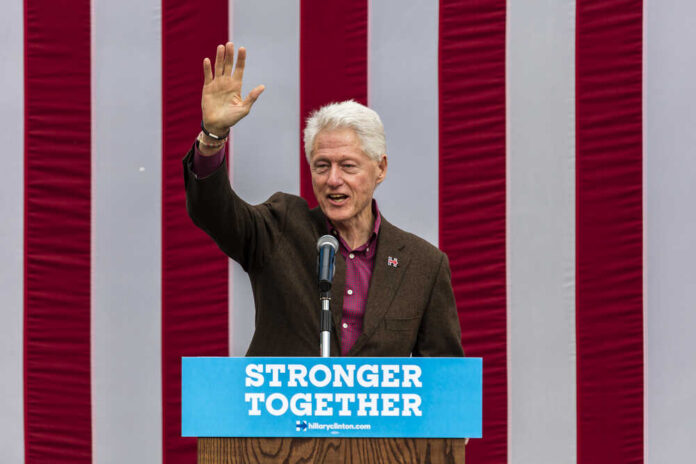
Bill Clinton mocked President Trump’s arch-and-brand agenda as “hard to make up,” then used it to question the administration’s priorities.
Story Snapshot
- Clinton blasted Trump’s triumphal arch and Kennedy Center naming fight in New York.
- Trump said the arch would double as a military complex with drones and snipers.
- A judge blocked efforts to put Trump’s name on the Kennedy Center without Congress.
- The administration admitted the arch site would cause “adverse effects” on views.
Clinton’s Jab Framed a Bigger Question on Priorities
Bill Clinton opened the Clinton Global Initiative by lampooning the Trump team’s focus on a Washington triumphal arch and the fight over the Kennedy Center’s name. He said the White House was “majoring in the minors,” and quipped that “some of this stuff — it’s hard to make up.”
The shot landed because it tapped a broad worry: are showpiece fights crowding out work that moves the needle? For older voters who remember lean, quiet competence, the contrast was the point.
"Some days I can hardly believe what is happening in this country that I love so much."
Bill Clinton takes direct aim at President Trump, accusing those in power of creating "one set of rules for themselves and another set for everyone else."
The former president goes further,… pic.twitter.com/PnB0VmuBOd
— Fox News (@FoxNews) September 22, 2026
Clinton’s case leaned on recent, concrete moves. He cited the push to rename the John F. Kennedy Center for the Performing Arts and the plan to build a triumphal arch in the capital.
Each, he argued, signals a taste for spectacle. He did not need to say Trump’s name for listeners to connect the dots. The criticism was not new, but the tone was sharper than his usual, and he tied it to governance, not just taste.
Trump’s Rationale: Security, Grandeur, and a Signature Stamp
Trump defended the arch as both a symbol and a tool. He said the military asked for it and that it would serve “national security” by housing drones and placing snipers on the roof and plaza areas.
That is a bold claim of public purpose. If accurate, it reframes the arch as infrastructure, not vanity. Supporters also pitched it as a grand civic statement fit for the capital’s scale and to honor nearby Arlington National Cemetery. That framing aims to blunt charges of ego.
The administration’s own filings still acknowledged tradeoffs. Officials said the chosen site would cause “adverse effects” on the setting and views along the river, but said those impacts “cannot be fully avoided” because the location is central to the project’s aims.
That admission invites a basic question voters ask in plain terms: do the benefits beat the costs you can see with your own eyes? On aesthetics and traffic, residents tend to notice when leaders get the vibe wrong.
The Kennedy Center Fight Hit a Legal Wall
Clinton’s other example brought a clean legal edge. A federal judge ordered the Kennedy Center to remove Trump’s name from its facade and blocked renaming without an act of Congress, pointing to the statute that designates the center as the memorial to John F. Kennedy.
That ruling undercuts claims that this was routine branding. The court’s message was simple: you cannot rewrite a memorial by muscle or board vote.
Legal experts and reporters noted the broader pattern: naming fights during a presidency rarely stick, and they invite backlash that outlasts any press hit. Scholars also argue that presidents use labels and symbols to set the agenda and crowd out policy detail.
That strategy can work short term, but it also raises the stakes when courts or the public push back. When the spectacle fails, it boomerangs and looks like mismanagement rather than strength.
What Clinton Got Right—and Where Voters Should Press Both Sides
Clinton’s charge that the administration is “majoring in the minors” has weight when paired with the court’s Kennedy Center rebuke and the arch’s admitted view impacts. His tone will grate on some, but the facts line up enough to test the White House on first things first.
If the arch is a security asset, the administration should show a sober plan, not a flourish. If the Kennedy Center is sacred by law, leaders should not play fast and loose with Congress’s role.
Voters over forty have seen this movie: big talk, sweeping symbols, and a hangover of cost and lawsuits. Good stewardship means clear priorities, clean process, and respect for institutions.
On that score, Clinton’s jab landed because it reflected a common-sense standard. The next chapter depends on whether the White House shifts from headline projects to meat-and-potatoes results—and whether critics keep their own focus on policy, not just punchlines.
Sources:
abcnews.com, thehill.com, www-cdn.abcnews.com, bbc.com, politico.com, www1.ku.de, en.wikipedia.org