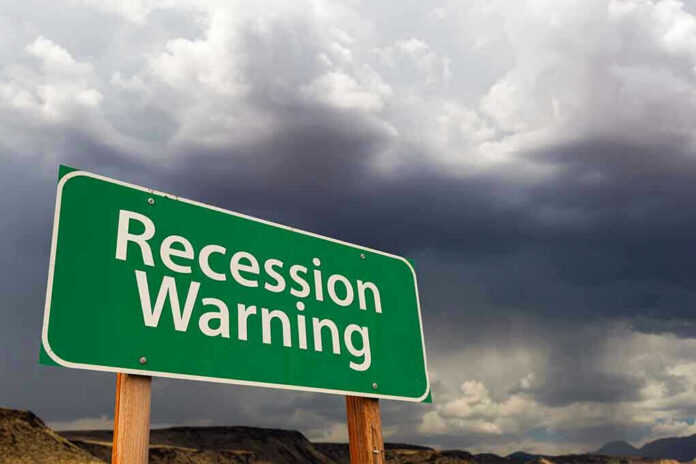
Unemployment crosses a historically perfect recession signal, threatening American families’ financial security amid skyrocketing costs and broken promises of peace.
Story Snapshot
- US unemployment rate breaks above its three-year moving average, a pattern that preceded every recession since 1950 with 100% accuracy.
- Polymarket traders now see a 35% chance of a recession by the end of 2026, up from earlier fears, as labor market cracks emerge.
- Iran war drains billions, driving gasoline to $3.98/gallon and inflation risks, fueling MAGA frustration with endless spending.
- Fed rate cuts and GDP resilience mask sluggish hiring, hitting working families hardest in Trump’s second term.
Labor Market Signals Historic Recession Warning
Société Générale strategist Albert Edwards released a chart showing the US unemployment rate crossing above its three-year moving average in early 2026. This trend has predicted every recession since 1950 without fail, across eight instances.
Sluggish hiring and declining job openings persist despite strong GDP and consumer spending. Families face a rising misery index at 7.3%, echoing pre-downturn fragility that conservatives warned against under fiscal mismanagement.
Goldman Sachs just raised US recession odds to 30%, the third bump in 90 days.
Growth is slipping below potential, oil is stuck around crisis levels, and credit is tightening into a weakening jobs market.
This is what the start of a recession actually looks like in real time.…
— StockMarket.News (@_Investinq) March 24, 2026
War Costs Amplify Economic Strain on Families
The ongoing war with Iran has cost over $20 billion, projected to hit $25 billion by week’s end. Gasoline prices surged a third to an average of $3.98, squeezing household budgets already battered by 2.7% YoY inflation and 4.6% unemployment since November 2025.
Trump supporters question endless regime change wars, high energy costs, and failure to keep America out of new conflicts, eroding trust in promises of prosperity.
Expert Divide Highlights Policy Distortions
Edwards warns no major forecaster sees a 2026 recession despite the chart’s perfect track record, countering bullish outlooks from J.P. Morgan and Goldman Sachs.
JPM predicts 2.2% growth, with inflation peaking at 3.6% mid-year due to tariffs, while Goldman eyes 2.8% global growth. Polymarket odds at 35% yes for recession reflect crowd wisdom amid 2025 policy shifts like tariffs and stimulus, distorting data baselines.
Stanford anticipates stable 4.6% unemployment with modest job growth, but the Sahm Rule’s 2024 false positive underscores the limits of indicators.
Yield curve steepening signals precedents, offset temporarily by consumer strength. Conservatives demand fiscal restraint as war funding requests top $200 billion, prioritizing families over global overreach.
Recession odds climb on Wall Street as economy shows cracks beneath the surface @CNBC https://t.co/HmBdIETUY6
— gmckae (@gmckae) March 25, 2026
Impacts Threaten Conservative Priorities
Short-term equity drops loom if labor weakens further, with long-term growth slipping to 1.7% in 2027 without more stimulus. Workers endure hiring slowdowns; consumers battle a higher misery index, straining households.
Political uncertainty from war and tariffs amplifies risks, disrupting NBER recession calls based on GDP quarters. Equities face the biggest threat, while commodities gain from Fed cuts—real pain hits Main Street families valuing limited government.
Sources:
One Chart Shows Why a Recession Could Still Be in the Cards in 2026
Polymarket: US Recession by End of 2026
J.P. Morgan: A Baseline Forecast for 2026
Stanford: US Economy 2026 – What to Watch