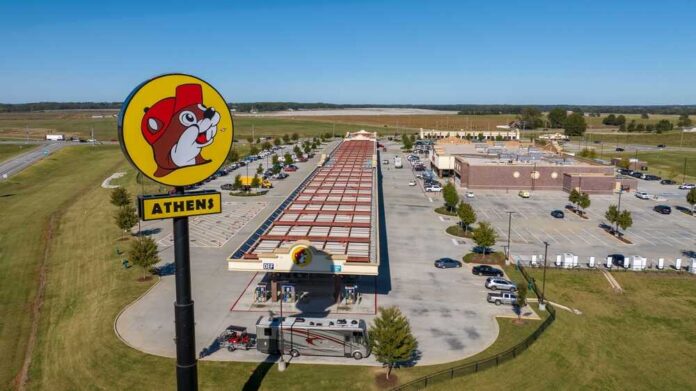
Oklahoma City moved a $25 million highway rebuild into motion to clear the path for Buc-ee’s at Interstate 40 and Cimarron Road.
Story Snapshot
- Mayor David Holt said talks are “very active” and named the I-40/Cimarron site.
- The City Council approved a three-party road agreement tied to the project.
- Funding splits name the city, state transportation officials, and a Buc-ee’s-linked firm.
- Reporters stressed the vote covers roads, not final store approval yet.
City names the site and signals the scale
Oklahoma City Mayor David Holt said the city is in active talks with Buc-ee’s and that the proposed location sits at Interstate 40 and Cimarron Road, on the west side of the city.
Multiple outlets ran Holt’s comments the same day, anchoring the site details across local and national coverage. That clarity matters because Buc-ee’s builds mega travel centers that pull heavy traffic. Any serious plan needs new lanes, wider bridges, and clean turnarounds right away.
The council vote focused exactly on that. Lawmakers approved an agreement to redesign and rebuild the junction to handle Buc-ee’s scale. Reporting says the plan expands the Cimarron bridge from two to five lanes, adds protected Texas-style turnarounds, and realigns ramps to prevent backups.
These are not cosmetic touches; they are the kind of concrete moves that let hundreds of cars cycle safely each hour. The message is simple: build the roads now so private investment can plug in.
Follow the money and the accountability
Funding responsibilities are named and measurable, which is a healthy sign for a public-private project. Coverage cites a split with Oklahoma City contributing $10 million, the Oklahoma Department of Transportation covering up to $15 million, and CSMS Management LLC, a company tied to Buc-ee’s leadership, paying up to $8 million, on a roughly $25 million package. When parties sign up for specific dollars, they place reputations on the line. Taxpayers get visibility, and the developer shows belief with cash at risk.
I can now finally confirm that we are in very active conversations with Buc-ee’s about their first location in Oklahoma City (and the State of Oklahoma), which will be located at Interstate 40 and Cimarron Road in West OKC.
There will be new infrastructure necessary to… pic.twitter.com/LYcvwum6d5
— Mayor David Holt (@davidfholt) September 29, 2026
Scope matters as much as money. Interchange upgrades target the exact choke points that define a Buc-ee’s opening day. Protected turnarounds keep local drivers and trailer rigs from weaving across lanes. Wider bridges add capacity for peak weekends and holiday surges.
Better ramps shape cleaner merges that reduce crash risk. These details may sound dry, but they are why some new locations boom while others create gridlock and buyer’s remorse. Good design pays dividends for decades.
What the vote did—and did not—decide
Reporters drew a clear line: the council approved the road project agreement; it did not grant final store approval. That is normal sequencing for a development of this size. Big-box travel centers cannot open on skinny roads.
Cities, states, and developers often stage the work so public infrastructure leads and private construction follows. The conservative view aligns with that order: build core public assets that serve all drivers, and let private capital compete to serve the demand created by safe, open roads.
Some timelines floated into the 2028 range, which signals that design, right-of-way, and bids must line up before shovels hit dirt. That pace may test patience, but it beats the sunk-cost trap of rushing.
A phased approach also shields taxpayers. If a private partner stalls, the improved interchange still serves freight, commuters, and nearby businesses. If the project advances, sales taxes and jobs from a first-in-state Buc-ee’s can help pay the public back many times over.
Why Buc-ee’s hones in on this corner
Buc-ee’s chooses interstates with regional pull, clean access, and growth corridors. Interstate 40 is a transcontinental artery. West Oklahoma City sits at the metro’s edge, where land is available and traffic disperses faster than in tight urban grids.
The site sits near Clarence E. Page Airport and draws from Yukon and beyond. That blend checks the boxes for a travel center that sells time as much as snacks: quick turns, easy fueling, and safe exits back to the highway.
Local debate surfaced about sprawl and downstream development. One council member raised concerns about wider growth patterns in the area. That argument is part of every frontier project. The facts on the table show a clean funding map, a targeted road design, and a mayor stating the talks are hot and the site is picked.
Sources:
foxbusiness.com, yahoo.com, rmb.reuters.com, kjrh.com, ktul.com, newson6.com, koco.com