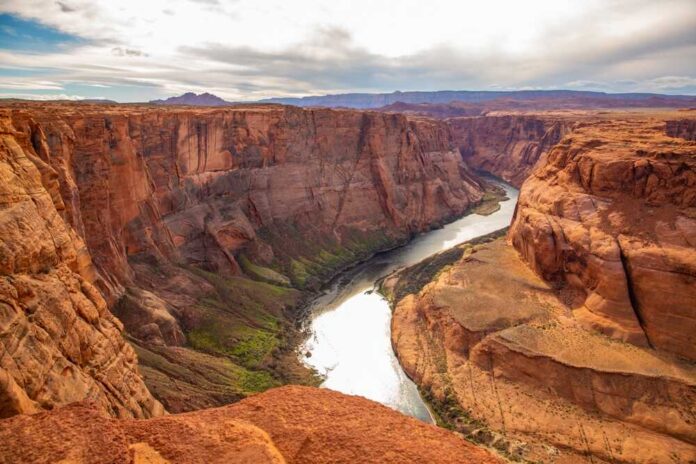
The second-largest reservoir in America is now less than forty feet from losing its power, and almost no one is being honest about what that means.
Story Snapshot
- Lake Powell is barely 35 feet above the line where Glen Canyon Dam stops making electricity.
- Federal forecasts say inflow this year is only about one-third of normal, so the cushion is shrinking fast.
- Washington cut water releases to slow the drop, but that fix clashes with decades of promises to cities and farms downstream.
- Advocacy groups and YouTube channels push doomsday talk, while federal agencies avoid plain language about “shutdown dates.”
Lake Powell Is Now Living Inside The Margin For Error
Lake Powell sits at a little above 3,524 feet today, roughly 175 feet below its full-pool elevation of 3,700 feet. Independent water trackers and federal data all show the same thing: the lake is only about one-quarter full and has been dropping roughly three feet every month over the last year.
The simple physical problem is easy to grasp. At 3,490 feet, Glen Canyon Dam’s turbines can no longer spin. Below that line, hydropower for millions of people goes dark.
Lake Powell, the second-largest reservoir in the U.S. located in Arizona and Utah, is nearing critically low water elevation levels, the latest data shows.
Read more: https://t.co/tYDgXZ8PgR pic.twitter.com/qkqLYovE1l
— ABC News (@ABC) July 14, 2026
The gap between today’s level and that shutdown line is now near 35 feet. For a lake that has already fallen more than thirty feet in a single year, that is not a safe buffer; it is a margin for error.
Federal engineers have warned for years about “minimum power pool,” the point at which electricity generation stops even though some water can still pass through the dam. The fact that Lake Powell is now hovering so close to that limit turns a long-term worry into a near-term operational risk.
The Numbers Behind A System Running On Empty
To understand why this is happening, look at the water balance sheet. The Bureau of Reclamation’s own forecast for water year 2026 says unregulated inflow to Lake Powell will be about 3.27 million acre-feet, only 34 percent of the long-term average.
That is like trying to refill a leaky swimming pool with a garden hose. Over the last two decades, combined storage in Lake Powell and Lake Mead has dropped by more than thirty million acre-feet as use has outpaced supply. That math is not partisan; it is physical reality.
Climate scientists and hydrologists point to a “megadrought” driven by warmer temperatures and lower snowpack across the Colorado River Basin. Less mountain snow means less spring runoff.
At the same time, cities and farms still draw water based on old legal promises made when the river was wetter.
This mismatch between twentieth-century paper contracts and twenty-first-century water flows is what Americans would call a classic case of ignoring limits and pretending someone else will pick up the tab.
Emergency Moves And Their Hidden Trade-Offs
Federal managers have not been asleep. In recent years, the Bureau of Reclamation cut annual releases from Lake Powell and staged emergency actions to protect both Lake Powell and Lake Mead.
The latest plan trims releases to around six million acre-feet to keep Lake Powell above the minimum power pool threshold and avoid a cascading power and water crisis downstream. That move helps the dam in the short run but shifts more risk onto users who rely on deliveries that were once treated as guaranteed.
States in the Colorado River Basin now wrestle with this trade-off. Upper Basin states like Utah and Colorado want to ensure that enough water is stored in Lake Powell to meet their future needs.
Lower Basin states like Arizona, Nevada, and California want steady flows to Lake Mead to keep taps running and fields watered. Someone has to take less.
Crisis Narratives, Advocacy, And The Quiet Federal Voice
While the numbers tighten, the public conversation gets louder and more dramatic. National outlets run headlines saying Lake Powell is “nearing dead power pool,” even though official documents are more careful and avoid that phrase.
Advocacy voices from groups that openly want Lake Powell drained entirely warn of civilizational collapse and permanent ruin. Their mission colors how they talk about the data, and readers are right to ask whether their worst-case language always matches the official numbers.
Lake Powell reaching critically low elevation levels, nearing 'dead power pool,' experts say
As of Monday, water levels at Lake Powell measured at 3,524.3 feet above sea level, according to the @USBR tracker. https://t.co/SzEBusvdse
Minimum, or "dead," power pool — in which… pic.twitter.com/p9T8qb8mJw
— Water Mark 🚰 (@OtayMark) July 14, 2026
YouTube creators pile on with daily countdown videos showing how many feet remain before “shutdown,” often without clear sourcing or context. This creates an echo chamber where emotional clips outrun sober analysis.
On the other side, the Bureau of Reclamation mostly sticks to dry elevation charts and forecast memos, offering almost no plain-spoken explanation about what a loss of hydropower would mean for households and budgets. That silence leaves a vacuum. Culture warriors turn a water math problem into a climate fight, and ordinary people are left trying to guess whose story to trust.
What A Conservative, Common-Sense Lens Sees Coming Next
A grounded look at Lake Powell’s situation starts with accepting hard facts. The reservoir is roughly one-quarter full, inflows are far below normal, and it is only a few dozen feet from losing its ability to produce power. Those facts do not depend on ideology.
The next step is to demand straight talk about trade-offs. Protecting hydropower may mean cutting deliveries. Keeping farm jobs may mean investing in new technology and shifting crops. Whatever the mix, pretending everyone can keep everything is not serious.
There is also a deeper warning here for how we manage big systems. The Colorado River crisis grew slowly over more than twenty years, as small shortages and modest droughts were brushed aside as “temporary.” That habit of delay is familiar in federal policy.
When data shows a large, long-term gap between promises and reality, leaders must act before the system drifts into the danger zone. Lake Powell tells us what happens when we ignore that rule. The water drops, the lights risk going out, and the options get worse.
Sources:
abcnews.com, usbr.gov, youtube.com, eros.usgs.gov, facebook.com, watereducationcolorado.org, powell.uslakes.info, colorado.edu, riversimulator.org