

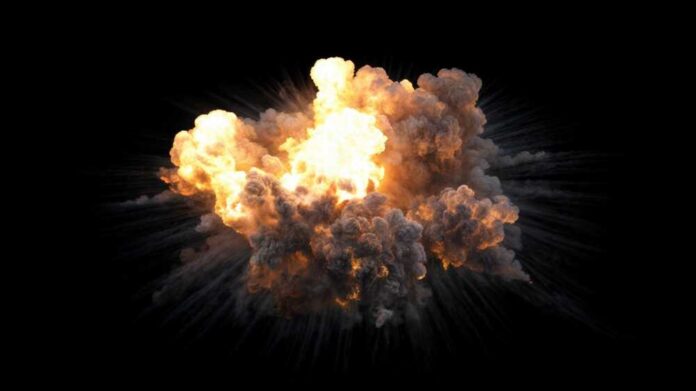
A massive explosion at a fireworks factory in China’s manufacturing heartland has claimed 26 lives, exposing the deadly price of corner-cutting in an industry that supplies seventy percent of the world’s pyrotechnics—and it won’t be the last.
See the videos below.
Story Snapshot
- Explosion at Huasheng Fireworks Manufacturing in Liuyang killed 26 workers, injured 61 more, with six in intensive care
- Blast occurred at 4:40 PM on May 4, 2026, collapsing structures and triggering secondary explosions from stored black powder
- President Xi Jinping ordered immediate accountability and halted production at all fireworks facilities across Liuyang
- Liuyang produces roughly 70% of China’s fireworks output and dominates global supply chains
- Company leadership detained as investigators probe chronic safety violations in China’s hazardous manufacturing sector
Death Toll Climbs as Rescuers Battle Secondary Blasts
The explosion ripped through the Huasheng Fireworks Manufacturing and Display Co. workshop with devastating force, shattering windows in nearby homes and sending plumes of black smoke into the sky above Liuyang, a city in Hunan province.
Within hours, more than 1,500 rescue personnel descended on the scene—firefighters, emergency responders, police, and medical teams working against the clock.
The initial death count of 21 climbed to 26 by the following afternoon as crews pulled bodies from the rubble. Victims ranged in age from their twenties to 68 years old, many trapped when the building collapsed.
At least 26 people were killed and 61 injured in an explosion at the Huasheng fireworks plant in Liuyang, China. Chinese President Xi Jinping has ordered an investigation. (Xinhua) pic.twitter.com/t1Sq3ggc8c
— World Vibe (@world_vibe_en) May 5, 2026
Rescue operations deployed robots to navigate unstable debris fields while crews sprayed water continuously to suppress smoldering fires and prevent further detonations from stockpiled gunpowder. Two black powder warehouses stood dangerously close to the blast site, forcing authorities to evacuate nearby residents.
By May 5, officials declared the search and rescue phase largely complete, though the grim work of identifying remains continued. Changsha Mayor Chen Bozhang issued an apology during a media briefing, acknowledging the scale of the disaster while emphasizing government response efforts.
The Fireworks Capital’s Deadly Track Record
Liuyang earned its reputation as China’s fireworks capital through decades of intensive production, churning out an estimated 70 percent of the nation’s pyrotechnic output. The city dominates global markets, supplying the brilliant displays that light up American Fourth of July celebrations and New Year’s Eve spectacles worldwide.
But this industrial prowess comes with a body count. The Huasheng explosion marks the latest in a long series of deadly incidents that have plagued the region. Just months earlier in February 2026, explosions at two fireworks shops during Lunar New Year festivities killed several people, underscoring seasonal vulnerabilities.
The pattern extends back years. A 2014 blast at a Yushu fireworks facility killed 43 workers. The catastrophic 2015 Tianjin chemical warehouse explosions—though not fireworks-related—claimed 173 lives and exposed systemic safety failures across China’s industrial landscape.
Liuyang itself has weathered multiple incidents between 2023 and 2025, many linked to illegal storage practices. Industry analysts estimate China experienced over 100 fireworks-related accidents annually before nationwide urban bans took effect around 2020.
Those restrictions pushed production deeper into rural areas like Liuyang, concentrating risk in communities least equipped to manage it.
Xi Demands Accountability in High-Risk Industries
President Xi Jinping’s swift response signals the political stakes involved when industrial disasters claim lives on this scale. He ordered “all-out efforts” for rescue operations, demanded a “swift” investigation, and called for “serious accountability” from those responsible.
His directive extended beyond this single incident, instructing authorities to tighten risk controls across key hazardous industries nationwide. The company head at Huasheng was detained immediately, and production ceased at every fireworks factory in Liuyang—an extraordinary move that idled the city’s economic engine overnight.
The government’s forceful response reflects genuine concern but also political calculation. Industrial safety failures embarrass Beijing and fuel public skepticism about regulatory enforcement.
Despite Xi’s previous crackdowns following disasters like Tianjin, reforms have consistently stalled at smaller enterprises, especially in sectors like fireworks manufacturing where volatile materials and thin profit margins create perverse incentives.
State media framed the Huasheng explosion as “controllable” through accountability measures, yet international observers see systemic corruption and a relentless prioritization of output over worker safety—problems that detention and production halts cannot solve.
Global Supply Chains Face Disruption
The immediate production shutdown across Liuyang carries implications far beyond China’s borders. With the city supplying such a massive share of global fireworks, the halt threatens inventory for upcoming celebrations from Independence Day in America to Diwali in India.
Distributors and event planners worldwide may face shortages and price spikes in coming months. For Liuyang’s workers and their families, the economic blow compounds the human tragedy—idled factories mean lost wages in a region where pyrotechnic manufacturing provides the backbone of employment.
Six victims remain in intensive care at Liuyang hospitals, most suffering severe bone injuries from falling debris and blast forces. The 61 injured survivors face uncertain futures, both physically and economically. Families of the 26 dead will seek compensation through government channels, though the amounts rarely reflect the true cost of lives lost.
The disaster exposes an uncomfortable reality: China’s dominance in hazardous manufacturing sectors rests on accepting casualty rates that would trigger comprehensive industry shutdowns in nations with stronger regulatory frameworks and genuine worker protections.
Sources:
Death toll rises to 26 in China’s latest fireworks factory explosion – South China Morning Post
China fireworks factory explosion kills 21 and injures more than 60 people – The Independent
Fireworks factory explosion kills 26 in Changsha, China – UPI
Fireworks plant explosion in China kills at least 26 and injures dozens of others – KUTV