

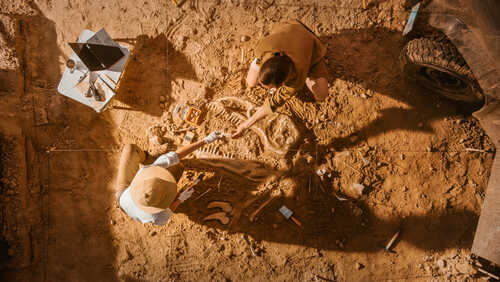
Scientists hauled nearly a thousand soil samples and new pottery shards from the slopes below Mount Ararat, and the hunt for Noah’s Ark just got a major upgrade.
At a Glance
- Excavation teams sampled close to 1,000 soil cores at the Durupınar site for lab analysis.
- Teams found pottery fragments from the Copper Age through the Iron Age near the boat-shaped formation.
- Prior analyses reported marine traces and clay-like materials dating back several millennia.
- Work proceeds under Turkish permits with a combined Turkish-international research effort.
Fieldwork Intensifies On Ararat’s Doorstep
Researchers advanced a major sampling push at the Durupınar site near Mount Ararat, a long-studied location shaped like a ship’s hull. The team reported collecting about 1,000 soil samples for detailed testing in Ankara, seeking patterns that match decayed wood or long-term human presence.
This surge follows earlier seasons that gathered dozens of targeted samples to test for distinct chemistry and microfossils. Officials granted permits for the campaign, which is coordinated with Turkish academic partners.
The larger aim is simple and bold: map what is natural and what is not. Scientists compare soil inside the outline to soil just outside it. If a vessel decayed there, the inner soils could hold more carbon, wood-related ash markers, or different acidity.
Prior lab work cited traces of clay-like materials and marine substances, which fit a human-occupied, water-influenced surface over time, though not proof on their own. This season’s haul will expand the dataset by an order of magnitude.
Pottery Shards Anchor Human Activity In Time
Researchers also reported pottery near the formation that spans key eras. Pieces linked to the Copper Age through the Iron Age suggest people were active in the area long before and long after the biblical window many imagine.
Pottery matters because it can be dated and tied to culture. If artifacts appear in layers that trace along the alleged hull, that would strengthen a case for organized work or settlement. If erosion scatters them, they still confirm a busy ancient landscape.
Ceramics by themselves do not equal a ship. Archaeologists will study composition, firing methods, and wear, then map artifact positions against the site’s microtopography. The team will also review whether roads, floods, or slope movement mixed the horizons.
Even so, distinct ceramic types from multiple eras frame the ridge as a corridor of travel and trade, which fits the long record of human movement across eastern Anatolia.
Noah’s Ark Mystery Deepens as New Discoveries Emerge Near Mount Ararathttps://t.co/yG9OGhBGyS
— Arkeonews (@ArkeoNews) September 23, 2026
Why These Samples Could Settle Old Questions
The Durupınar formation has drawn claims and counterclaims for decades. Critics often argue it is a natural mudflow ridge shaped by erosion, not a buried craft. Proponents answer with geophysical scans and chemical differences inside the outline.
The most durable way to cut through that standoff is a thick, transparent dataset that many labs can review. The current push for nearly a thousand samples aims at that standard, stacking robust statistics over narrow tests.
Earlier analyses reported signs of repeated water influence and possible human-linked deposits, including clay-like materials and marine remnants dated to several thousand years before present. Those findings raised interest but also called for replication and tighter controls.
This season’s sampling grid, plus strict chain-of-custody and comparative controls, will help confirm which signals are site-wide and which are local quirks. If the inner-outer contrast holds strong, the argument gains weight.
What To Watch Next: Stratigraphy, Not Slogans
The next inflection point will not be a headline; it will be stratigraphy. Labs will slice cores layer by layer and ask: do chemistry, microfossils, and any organics align in coherent bands? Do layers match a shaped hull footprint, or do they reflect standard hillside processes?
Teams will also track whether pottery occurs in intact layers that respect the site’s geometry or in mixed, downslope fans. Clean, repeated patterns would be the tipping point.
🔥🔥 Noah's Ark 🔥🔥
After 70 years, Researchers with @noahsarkscans have secured permits and begun core drilling at the Durupinar site near Mount Ararat in eastern Turkey.
Genesis 8:4: "And the ark rested in the seventh month, on the seventeenth day of the month, upon the… pic.twitter.com/tagKOCgrbi
— KJofTikTok (@TheKJofTikTok) September 23, 2026
If the expanded sample set confirms strong inner-outer differences, grounded in lab repeats and shared datasets, confidence should rise. If signals blur under scrutiny, the formation may stand as a striking natural monument with a long human footprint around it. Either way, the facts will speak when the lab reports land.
Sources:
metro.co.uk, dailymail.com, jpost.com, x.com