
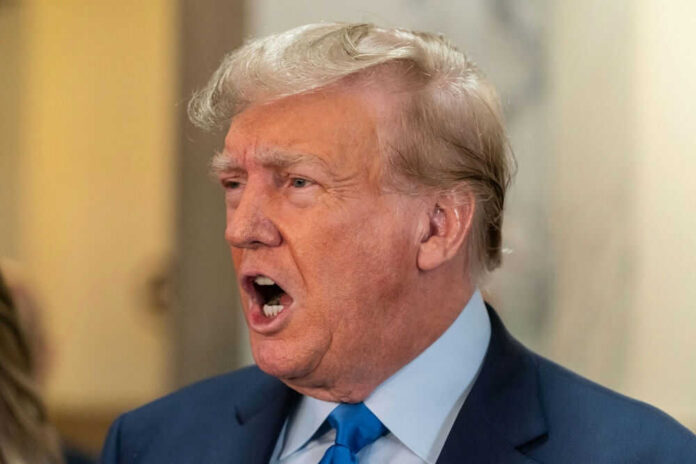
Trump’s newest polling low does not just measure discontent; it exposes how soft his second-term political foundation may have become.
Story Snapshot
- A New York Times/Siena poll pegs Trump’s job approval at 37%, his lowest mark of the second term.
- Independent trackers show him hovering in the high 30s to about 40%, confirming a real slump, not a one-off outlier.
- Conservatives now face a hard question: is this media spin, or a warning light on the dashboard of 2026 politics?
- The answer lies in the trend line, not in one headline-making survey.
Trump’s 37 Percent: Polling Floor Or Just Another Bump?
The headline number is simple enough: the latest New York Times/Siena survey clocks President Donald Trump’s approval at 37 percent, flagged as a second-term low. Media commentators quickly framed it as a “crack in the floor,” suggesting Americans are reassessing the Trump project after the adrenaline rush of his 2024 comeback. Supporters counter that the Times and Siena College have never exactly been friendly terrain and warn against taking a single poll as holy writ.
Trump approval rating hits second-term low in new pollinghttps://t.co/05kx1RraoA
— The Hill (@thehill) May 18, 2026
Broader data, however, does not rescue Trump from the basic story that he is unpopular. A separate polling average of presidential approval places him at roughly 36.7 percent approval and about 59.9 percent disapproval in mid‑May 2026, almost exactly bracketing that 37 percent New York Times/Siena result. [1] Statista’s independent tracker has his approval “about 40 percent” as of early May, still well below the comfort zone for an incumbent president. [4] The neighborhood is clear: mid‑to‑high 30s, maybe scraping 40 on a good day.
Why A Single Poll Becomes A Proxy War
Every time a president’s approval dips into the thirties, the real fight stops being about the president and starts being about the poll. Trump’s critics point to the 37 percent as proof the public is finally waking up. His supporters argue that without the full questionnaire, field dates, and weighting methodology, the number is just another product of an establishment media house that has underestimated him before. Both camps use the same data point as a weapon, which tells you more about our polarization than about statistics.
Polling professionals, including many who are not fans of Trump, would argue that this is the wrong way to read the numbers. They do not treat a single survey as a verdict; they treat it as a noisy signal. House effects, sample composition, and question order can nudge approval up or down several points. That is why the smart move is to ask one question: does the new poll align with the larger trend? In Trump’s case, multiple independent sources say yes. [1][4]
What The Trend Says About Trump’s Coalition
The trend line tells a more nuanced story that should bother Republicans who care about governing, not just winning the next fight on social media. The New York Times/Siena polling operation previously found Trump underwater nationally at 40 percent approval and 56 percent disapproval after his first year back in office. The current 37 percent headline sits not far below that, but the direction is wrong: slightly down, not up, after more time to prove competence and stability.
Other public polling shows the softening happening in familiar weak spots: younger voters, Hispanic voters, and Americans who sat out the 2024 election. [4] For conservatives who believe in expanding the tent, not shrinking it, that pattern matters more than the exact decimal point on today’s approval rating. Losing ground with persuadable voters, while holding steady with loyalists, is the formula for winning arguments online and losing margins in real elections.
Media Narratives, Conservative Skepticism, And Common Sense
Conservative skepticism of elite media polling is not paranoia; it is a learned response. The same New York-based outlets that misread Trump in 2016 and 2020 now trumpet every downtick as a “crumbling base.” Many on the right roll their eyes, and with good reason. They remember that Trump has outperformed polls before and that newsrooms treat a three‑point move like a stock-market crash whenever his name is attached. That institutional bias deserves scrutiny.
Yet common sense says you do not dismiss every bad number simply because you dislike who published it. When a New York Times/Siena survey at 37 percent lines up with a nonpartisan approval average at roughly 36.7 percent and a separate Statista estimate near 40 percent, the conservative response should not be denial; it should be diagnosis. [1][4] Where is trust eroding? Which policies are not landing? What promises feel unkept or overshadowed by drama? Those are the questions serious adults ask.
Why This Moment Matters More Than The Number
Presidential approvals in the thirties do not automatically predict defeat; Ronald Reagan, Barack Obama, and Trump himself have all seen rough patches. The danger comes when low numbers harden into a story voters tell themselves: chaos instead of competence, conflict instead of results. Once that story cements, every new headline flows into the same channel. The 37 percent figure matters less as a snapshot and more as evidence that such a story could be taking hold.
For conservatives, the strategic takeaway is simple and sobering. If you want the Trump project to endure beyond one man and one term, you cannot shrug off sustained unpopularity as “fake news.” You must look past the media spin, study the trend, and demand performance that earns the public’s trust rather than just its outrage. The New York Times/Siena poll might be biased at the margins; the discomfort it reveals, however, is very real.
Sources:
[1] Web – Latest Donald Trump Approval Polls and Average for 2026
[4] Web – Trump presidential approval rating U.S. 2026 – Statista