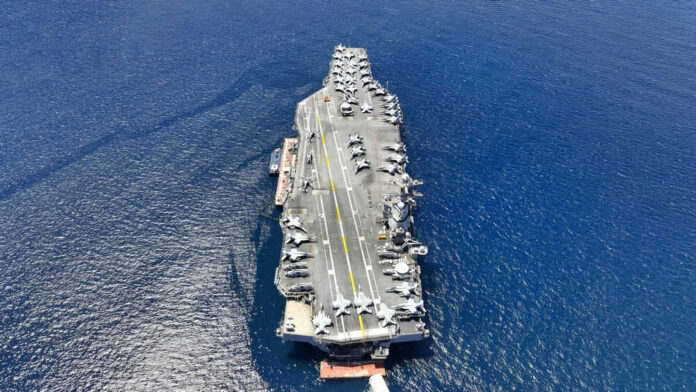
President Trump’s massive U.S. carrier strike group now stares down Iran, delivering a clear message of American strength against nuclear threats and regime aggression.
Story Highlights
- USS Abraham Lincoln Carrier Strike Group arrives in the Middle East, positioned near Iran with F-35C stealth fighters and Tomahawk-armed destroyers.
- First major deployment since 2025 strikes on Iran’s nuclear sites, bolstering deterrence amid IRGC threats to U.S. bases.
- Supporting assets include B-52 bombers in Qatar, F-15Es in Jordan, and missile defenses heading to Israel.
- Trump orders the move, signaling readiness while hoping to avoid conflict, as Iran cracks down on protests.
- Positioning near the Strait of Hormuz guards 20% of global oil and counters Iran’s asymmetric threats.
USS Abraham Lincoln Strike Group Deploys Near Iran
Israel’s Channel 13 reported the USS Abraham Lincoln carrier strike group reached the Middle East on Sunday evening. The group is positioned near Iran in the Gulf of Oman and the Arabian Sea. Arleigh Burke-class destroyers with Tomahawk missiles and the USS Mobile Bay cruiser accompany the carrier.
Carrier Air Wing 9 equips the group with F-35C Lightning II stealth fighters, F/A-18E/F Super Hornets, EA-18G Growlers, and E-2D Hawkeyes. This deployment marks the first major U.S. carrier presence since the June 2025 strikes on Iranian nuclear facilities.
The U.S. Navy’s Lincoln carrier strike group has arrived in the Middle East, per Israel’s Channel 13.
The group brings significant strike and air defense capabilities to the region. pic.twitter.com/XIHgajZolX
— OSINTtechnical (@Osinttechnical) January 25, 2026
Trump Orders Redeployment Amid Escalating Tensions
President Trump directed the redeployment of the strike group from the Asia-Pacific through the Strait of Malacca on January 20. U.S. officials announced the movement on January 22, with Trump describing a “big flotilla” heading to the region. He expressed hope to avoid action but emphasized readiness against Iranian nuclear escalation and protester crackdowns.
Iran’s IRGC issued threats, including videos targeting U.S. bases, and declared a “finger on the trigger” stance per Supreme Leader Ayatollah Ali Khamenei. Post-2025 Operation Midnight Hammer, these moves restore U.S. deterrence.
Supporting Air and Defense Assets Converge
U.S. Air Force deploys F-15E Strike Eagles to Jordan and B-52 Stratofortress bombers to Qatar. A missile defense vessel heads to Israel, with Patriot and THAAD systems deploying regionally.
C-17 cargo jets and tankers support logistics as of January 26, 2026. Allies bolster efforts: U.K. RAF Typhoon squadron operates from Qatar under hosting agreements, and Qatar and Jordan accommodate U.S. forces.
This multi-layered buildup provides missile defense, strike options, and rapid response capabilities near the Strait of Hormuz.
The U.S. holds offensive superiority with advanced Tomahawks, F-35Cs, and bombers against Iran’s asymmetric tactics like Hormuz disruptions or proxy attacks. Alliances with Israel, the U.K., Qatar, and Jordan counter IRGC influence, prioritizing American interests and regional stability.
Implications for Energy Security and Global Stability
In the short term, the deployment deters Iranian reprisals and protects U.S. ally assets, enabling swift strikes if needed. Long-term, it signals a sustained U.S. commitment, though escalation risks global energy disruptions by threatening Hormuz, affecting 20 million barrels per day of oil transit.
Economic volatility looms in energy markets, while defense sectors see demand for Patriot and THAAD systems. Politically, it heightens the U.S.-Iran standoff but strengthens alliances. Iranian protesters face regime crackdowns amid heightened alert states in Gulf nations and Israel.
Military analysts describe the carrier strike group as adding substantial offensive capability and supporting limited operations, such as decapitation strikes. U.S. officials stress a defensive posture amid unpredictability, differentiating from prior routine increases.
Geopolitical experts view it as prioritizing deterrence post-2025 patterns. No major contradictions exist in the timelines or assets, though the exact striking intent remains defensive rather than preemptive.
Sources:
U.S. aircraft carrier strike group reaches Middle East: Report
Jerusalem Post article on U.S. officials’ announcements
The War Zone on military buildup including Trump’s flotilla comments
Geopolitical Monitor on U.S. military posture shift