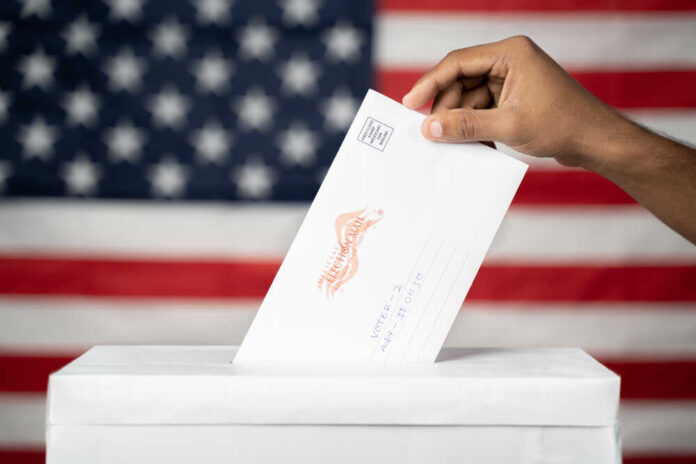
USPS moved from sorting ballots to scoring them, and the shift puts barcode data and voter lists at the center of who gets mail ballot service for federal elections.
Story Snapshot
- USPS proposed and then issued rules tying ballot mail service to state-submitted voter lists with unique barcodes.
- A new Federal Ballot Mail Portal and serialized Intelligent Mail barcodes would track outbound and return envelopes.
- USPS says the system helps enforce federal law and supports law enforcement; critics call it federal overreach.
- Implementation depends on court action, leaving the rule real on paper but paused in practice.
What USPS Actually Put On The Table
USPS published a proposed rule in the Federal Register in June 2026 that retools ballot mail for federal elections. The plan links service to state enrollment in a federal portal and to the use of uniquely serialized Intelligent Mail barcodes on outbound and return ballot envelopes.
It also requires states to provide the names and addresses of intended mail-ballot recipients with the matching barcodes. The agency framed it as an operations and compliance upgrade, not a change to voter eligibility rules.
The United States Postal Service has released a new rule adding verification requirements to all mail-in ballots. https://t.co/How6zwugny
— ABC News (@ABC) August 23, 2026
USPS later issued a final rule in late August 2026, formalizing the barcode-and-portal standards and the requirement for state-submitted recipient data. The rule’s stated goal is visibility: ensure every ballot envelope is traceable from print to delivery and return.
USPS also stated the tracking data will help check adherence to federal law and aid law enforcement when needed. The agency limited the scope to federal elections, not primaries, to narrow the policy footprint.
How The System Would Work Day To Day
State election offices would enroll in a Federal Ballot Mail Portal. Before mailing, they would upload a list of each voter slated to get a ballot, with name, address, and a unique barcode matched to the outbound and return envelopes.
USPS would use that list to verify ballot mailings as they enter the mail stream. The barcodes would link each piece to a recipient and allow end-to-end tracking at postal facilities, creating an auditable chain of custody across sorting and delivery.
USPS already sets baseline standards for election mail, including design and handling practices detailed in its longstanding user’s guide. The new rule builds on those logistics rules by adding pre-mail verification and serialized tracking.
Supporters call it a leap in standardization that closes gaps across states. Opponents say it moves USPS beyond logistics into a gatekeeping role over ballot delivery, which they argue belongs to the states or to Congress if national rules are needed.
The Case For Tighter Tracking, And The Pushback
Backers, including a coalition of Republican attorneys general, argue unique barcodes and uniform envelopes reduce chain-of-custody problems and help spot misdirected or duplicate mailings.
They say tracking is normal in commerce and should apply to ballots, which carry higher stakes. Their comments urge quick adoption so every ballot can be traced with the same clarity as a package and exceptions can be flagged before Election Day rather than after.
The USPS Published its Mail-In-Ballot Rules For the Midterm Elections…This is HUGE.
The USPS just published a new rule implementing Trump’s executive order on mail-in ballots.
States that want the Postal Service to handle their mail-in or absentee ballots must now:
-Turn… pic.twitter.com/EuVuak4Stk
— Americaforever (@onetexgal9) August 23, 2026
Opponents, including a multistate group led by Democrat attorneys general, warn that USPS would become an “unprecedented gatekeeper” by refusing ballot mailings that do not match its portal list. They also cite privacy, burden, and timing concerns.
They argue registration checks, eligibility confirmation, and signature or identification verification already protect mail voting. They say the rule adds federal control without proving a clear fraud-fighting benefit that current safeguards lack.
Conservative Lens: Security, Federalism, And Practical Proof
The security case aligns with conservative values on order, verification, and clear records. Serialized barcodes and pre-mail checks create a clean audit trail. That said, good policy also respects federalism and proves value.
The record shows USPS claims about enforcement and law-enforcement support but offers little hard data that barcode-linked lists will catch fraud at scale beyond what states already catch. A time-limited pilot or public metrics would strengthen the case while easing state concerns.
Federalism also matters. USPS can set mail-handling standards. Conditioning ballot acceptance on state-submitted voter-level data edges toward eligibility control. Congress, not an agency, should draw that red line if one exists.
A narrow fix respects both aims: keep the barcodes and tracking for every ballot, but require only the minimum data needed for logistics and audits, with bright-line bans on using portal data to judge eligibility or slow lawful mailings.
What Happens Next
USPS says it will not implement the new standards unless a court lifts an injunction. That means election offices keep current practices for now. The prudent path is parallel planning. States can test serialized barcodes and portal-style uploads in controlled pilots.
USPS can publish retention rules, access controls, and audit protocols. If the courts green-light the rule, a phased rollout with clear error handling beats a rushed flip that risks confusion in a close race.
Voters want two things at once: ballots that arrive and a process they can trust. Tracking is normal, but trust needs proof. Show that the barcode-and-list system reduces misdeliveries, speeds curing, and flags errors without blocking lawful voters.
Publish the numbers, not talking points. Do that, and this stops being a fight over power and becomes a simple promise kept: every legal ballot, counted once, tracked from start to finish.
Sources:
abcnews.com, app.govly.com, reuters.com, grayhairsoftware.com, about.usps.com, nul.org, usatoday.com, krishnamoorthi.house.gov